New Turkesterone (phytoecdysteroid from Ajuga turkestanica) Published Apr 4, 2026
Spinach, Steppe Herbs, and the Myth of the 'Natural Steroid': The Real Story of Turkesterone
Potential small improvements in strength and muscle with training—mostly shown for ecdysterone, not turkesterone; possible bone and metabolic effects remain exploratory.
Evidence summary
Turkesterone, the plant steroid marketed as a natural anabolic, does not improve body composition in active adults, while the stronger human strength signal belongs to ecdysterone.
- A 4-week randomized trial in active adults found turkesterone 500 mg/day did not change body composition versus placebo.8
- A 10-week resistance-training trial in trained humans found ecdysterone improved strength versus placebo.
- Human evidence remains sparse, and mechanistic work points to ERβ signaling rather than androgen receptor activation.
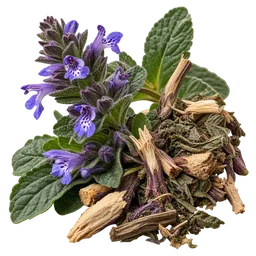
You hear the pitch at the gym: "It's like steroids—but natural." The bottle says turkesterone, a plant steroid from a Central Asian herb. But when scientists followed the clues, the trail didn't lead where marketers promised.
A rumor from the mountains
The story begins in the Pamir–Alay ranges of Uzbekistan, where Ajuga turkestanica grows among rocks and wind—its Uzbek folk names and uses recorded in ethnobotanical notes and even cosmetics patents that describe it as a tonic herb brewed as tea1215. Decades later, bodybuilders would this plant for a molecule named turkesterone, part of a wider family called ecdysteroids. These are the hormones that help insects molt; some plants make them as a clever deterrent to hungry bugs.
The twist: spinach enters the chat
Ecdysteroids aren't unique to Ajuga. Spinach carries one—ecdysterone (20-hydroxyecdysone)—that vaulted into headlines in 2019 when a WADA-backed team ran a 10-week, double-blind study in trained humans. The ecdysterone group gained more strength than placebo while lifting, enough that investigators urged anti-doping authorities to monitor the compound7910. As Prof. Maria Parr put it for the university release, the data were strong enough to consider adding ecdysterone to the prohibited list, noting its actions on the body's estrogen-beta receptor and the impracticality of eating "kilograms of spinach" to match the capsule dose911. WADA soon placed ecdysterone on its Monitoring Program, tracking patterns of use worldwide61314.
"After the ten-week study period, the athletes who actually took ecdysterone showed a significantly higher increase in maximum muscle strength." — Freie Universität Berlin media summary9
But what about turkesterone?
Here the plot thickens. Despite online hype, the only randomized, placebo-controlled trial of turkesterone itself (500 mg/day for four weeks) found no effect on body composition in active men and women812. That doesn't close the case—four weeks is short, and the study didn't track strength—but it does mean the bold transformation stories belong, so far, to ecdysterone, not turkesterone.
How could a "plant steroid" act in humans?
Scientists once suspected these molecules worked like testosterone. The emerging picture is more nuanced: ecdysteroids appear to nudge the estrogen-beta receptor (ERβ)—a switch found in muscle and bone that can spur protein building without the androgenic baggage of classic steroids. In animals and cells, ecdysterone enlarged muscle fibers; blocking ERβ dimmed the effect23. Even in 2025, computational modeling favored a stable, selective embrace between ecdysterone and ERβ, offering a mechanistic "fit" that differs from testosterone's receptor14. In bone models, beta-ecdysterone pushed stem cells toward bone-making programs and eased osteoporosis in mice, again via estrogen-linked signaling5. Think of ERβ as a quiet foreman on the job site: flip his clipboard to "build," and muscle and bone crews get to work—without the rowdy side effects of the androgen crew next door.
The "Russian secret," the lab reality
Stories swirl that Soviet athletes used these extracts. What is clear is contemporary anti-doping labs now detect ecdysterone use in urine, have mapped its human metabolites, and warn that supplement labels are often wrong1316. Independent surveys of ecdysterone products show serious discrepancies—some under-dose, some contain other substances, even prohibited ones1618. A 2020 analysis found actual ecdysterone content generally much lower than labels claimed17. More recent industry testing has alleged substitution with the wrong plant entirely in certain "turkesterone" products—another reason to be cautious about the bottle's promise19.
Tradition meets modern curiosity
Ajuga species have long been used across Eurasia for everything from aches to tonics201221. Chemists confirm that A. turkestanica really is rich in ecdysteroids—turkesterone among them—alongside other bioactives2223. That chemical abundance is why Ajuga became a source plant for today's supplements.
What we actually know (so far)
Human performance: One controlled 10-week trial suggests ecdysterone plus training improves strength; turkesterone's first RCT (4 weeks) showed no body composition change; strength was not reported98.
Mechanism: ERβ looks like the main door these molecules walk through—supported by rodent, cell, and computational lines of evidence2314.
Safety and regulation: There are no FDA-approved drugs with ecdysteroids; WADA monitors ecdysterone but hasn't banned it. Athletes should still be cautious because product quality varies and positives can occur if products are contaminated1461617.
"At present, there are no FDA-approved medications that contain ecdysteroids.. WADA added it to the Monitoring List in 2020." — USADA advisory for athletes14
Practical ways to think about it
If you're a trained lifter looking for a small, possible edge, the best human data point to ecdysterone at multi-week doses with resistance training. If you're eyeing turkesterone, understand that its evidence in humans is early and negative on body composition at four weeks, with strength effects untested in that trial8. Either way, the biggest variable is product authenticity. Choose brands with third-party testing for ecdysteroid content (ideally specifying both ecdysterone and turkesterone) and purity screens for WADA-listed adulterants1617. For bone or metabolic curiosity, recognize that evidence sits mostly in cells and animals. It's a promising hypothesis, not a prescription5.
The road ahead
Anti-doping scientists have done much of the recent heavy lifting: defining how to detect use, what metabolites appear, and how often athletes are exposed1316. What's missing are longer, well-controlled trials directly testing turkesterone—standardized extracts, verified content, and strength-plus-composition outcomes over 8–12 weeks. Only then will we know if turkesterone can match its cousin's headlines or if the spinach story remains the star.
Bottom line
Turkesterone's legend is loud; its human evidence is quiet. Ecdysterone has the stronger case for now. If you experiment, treat this like science: demand verified products, run it alongside smart training, and judge results at the barbell—not the label.
Key takeaways
What to walk away with
- 01
Ecdysterone showed strength gains in a 10-week human study; turkesterone has weaker human data.
- 02
Mechanism: likely nudges estrogen-beta receptors in muscle and bone, not testosterone pathways.
- 03
WADA monitors ecdysterone; USADA notes no FDA-approved uses—athletes should be cautious.
- 04
Supplement labels often misstate content; third-party testing is essential.
- 05
Traditional Ajuga uses exist, but modern claims outpace clinical trials.
Effect timeline
When to expect what
- Immediate
- No
- Peak
- 8-10 weeks (shown for ecdysterone with training)
- Duration needed
- 8-12 weeks minimum (extrapolated from ecdysterone trial; turkesterone unknown)
- Wears off
- Likely within weeks after stopping; not well studied
Research trajectory
What the studies actually show
-
Ecdysterone supplementation for 10 weeks with training increased strength vs. placebo in trained humans. 9
A WADA-commissioned, multi-lab effort that led to inclusion on the Monitoring Program.
First modern human performance signal for an ecdysteroid.
-
Turkesterone 500 mg/day for 4 weeks did not change body composition vs. placebo in active adults. 8
First RCT specific to turkesterone; short duration and no strength outcomes reported.
Tempers marketing claims; calls for longer, stronger trials.
-
Mechanistic work suggests ecdysteroids act via estrogen receptor beta, not androgen receptor. 2
Rodent/cell studies (2014) showed ERβ involvement; 2025 simulations corroborate selective ERβ binding.
Explains why effects differ from testosterone and may have a cleaner side-effect profile.
Human trials
What real trials found
-
Ten-week, double-blind trial where ecdysterone users gained more strength than placebo during resistance training. 9
- Outcome
- Significantly higher increase in maximum strength; recommendation for WADA monitoring.
- Why it matters
- Shows human performance signal—though for ecdysterone, not turkesterone.
- Source
- Freie Universität Berlin media summary and related publications
-
Four-week randomized trial of turkesterone 500 mg/day in active adults. 8
- Outcome
- No effect on body mass, lean mass, or body fat vs. placebo.
- Why it matters
- Direct human data on turkesterone; suggests caution with claims.
- Source
- Research Directs in Health Sciences (2024)
-
Analyses of commercial ecdysterone supplements. 16
- Outcome
- Frequent mislabeling; some products lacked actives or contained prohibited substances.
- Why it matters
- Quality control is a practical barrier to real-world results.
- Source
- Separations (2023) and JPBA (2020)
Expert insights
Voices in the field
After the ten-week study period, the athletes who actually took ecdysterone showed a significantly higher increase in maximum muscle strength. 9
At present, there are no FDA-approved medications that contain ecdysteroids... WADA added it to the Monitoring List in 2020. 14
Practical guidance
Putting it to use
Who may benefit
Trained lifters seeking a modest, potential edge when training hard; individuals curious about ERβ-mediated approaches rather than androgenic ones.
Dosing
Human performance data exist for ecdysterone over ~10 weeks alongside resistance training; turkesterone data at 4 weeks showed no composition change. If tried, evaluate over 8–12 weeks with verified content.
Timing
Benefits, when seen, accumulate with training over weeks—not hours. There's no acute 'kick'.
Quality
Select products with third-party assays for ecdysterone/turkesterone content and screens for WADA-listed adulterants; mislabeling is common.
Cautions
Athletes in tested sport should verify products and consult anti-doping resources, as ecdysterone is monitored and contamination risks exist.
A closing thought
Nature often whispers before it shouts. Turkesterone may yet have a voice, but for now the clearest chorus comes from spinach's cousin molecule—and from the lab benches that keep our stories honest.
Frequently asked
Common questions
Is turkesterone banned in sports?
Does turkesterone build muscle in humans?
How is turkesterone different from ecdysterone?
What dose should I take?
Related
More on this supplement
Pulled from across the site — rankings, comparisons, combinations, and reviews where this supplement shows up.
Sources
- 1. Molecular insights into the role of ERβ in Ecdysterone's anabolic activity (2025) (2025)
- 2. ERβ is involved in skeletal muscle hypertrophy induced by ecdysterone (2014) (2014)
- 3. Prime PubMed summary of ERβ involvement (2014)
- 4. Chapman Univ. repository for ERβ modeling paper (2025)
- 5. Beta-ecdysterone promotes osteogenic differentiation; alleviates osteoporosis in mice (2008)
- 6. WADA project: Ecdysterone detection in anti-doping control (2020, completed) (2020)
- 7. Agilent press release on WADA-backed ecdysterone study (2019)
- 8. A Preliminary Investigation of Turkesterone: It's Not Deca (2024 RCT) (2024)
- 9. Freie Universität Berlin media summary: Spinach extract improves performance (2019)
- 10. MedicalXpress coverage of the ecdysterone trial (2019)
- 11. ACSM abstract: Performance enhancing effects of ecdysterone (2019) (2019)
- 12. Ajuga turkestanica (overview with 2024 turkesterone RCT reference) (2025)
- 13. WADA project: Ecdysterone as non-conventional anabolic agent, Part 2 (2018)
- 14. USADA: What athletes need to know about ecdysteroids (2020)
- 15. EP1231893A1 Ajuga turkestanica extract and cosmetic uses (traditional notes) (2002)
- 16. Separations (2023): Quantitation of ecdysterone and targeted analysis of WADA-prohibited substances in ecdysterone supplements (2023)
- 17. JPBA (2020): How reliable is dietary supplement labelling? Ecdysterone case study (2020)
- 18. Investigations into the human metabolism of ecdysterone (2023) (2023)
- 19. PR Newswire: Nootropics Depot reveals turkesterone test results (2025) (2025)
- 20. MDedge profile: Ajuga turkestanica traditional uses (2012)
- 21. Ethnopharmacology of the genus Ajuga (review) (2009)
- 22. The minor ecdysteroids from Ajuga turkestanica (2015) (2015)
- 23. MDedge: Constituents reported in A. turkestanica (2012)
1,120 words · 23 sources · Turkesterone (phytoecdysteroid from Ajuga turkestanica)