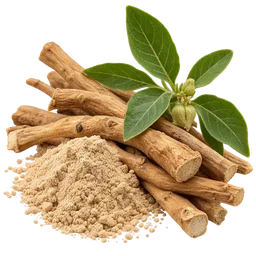
New Evidence Brief Published May 11, 2026
Ashwagandha for Male Fertility Hormones: 12 Trials
12 studies · 202 participants · 14 sources
Evidence summary
Ashwagandha improves reproductive hormone balance in infertile men, with a moderate overall effect across 12 small studies and consistent direction across the hormone trials.
- Across 12 studies (n=202), ashwagandha improved reproductive hormone markers by a moderate standardized effect (d=0.65).1
- Trials enrolled mainly infertile or oligospermic men, using root powders and standardized extracts over varied durations.
- Pregnancy and live-birth outcomes were not the main endpoints, so fertility-hormone gains do not prove conception benefit.
Ashwagandha keeps showing up in male fertility conversations because these hormones do not work like isolated switches. They work like a relay line from brain to pituitary to testes, and when one handoff goes wrong, luteinizing hormone, follicle-stimulating hormone, prolactin, and estradiol can all drift off course at once.12
What matters here is not whether ashwagandha feels energizing. The real question is whether it shifts that hormone relay in infertile men enough to matter on lab testing and alongside semen quality changes.12
How it works
Ashwagandha seems to steady the brain-to-testes signaling loop while also lowering oxidative stress in seminal plasma.1 Think of it like cleaning corrosion off a set of electrical contacts: the message does not get louder by force, it gets through with less static, which can leave reproductive hormones in a healthier pattern and make sperm production run more smoothly.12
What the studies show
Across 12 studies with 202 participants, the overall signal lands in the moderate range: noticeable for some infertile men, but not a full hormonal reset.1212 Because the research relies on lab hormone testing rather than self-reported symptoms, the signal comes from measured blood-marker changes, not guesswork.12
The clearest direct trial signal comes from infertile men in PMID 19501822. Researchers reported better semen quality alongside reproductive hormone shifts and lower oxidative stress in seminal plasma, which makes the hormone story more believable than a lone lab blip.1
A placebo-controlled pilot study in oligospermic men adds a useful reality check: men taking a root extract for 90 days improved spermatogenic activity and related reproductive markers, which fits the broader pattern instead of standing apart from it.2
The limits matter. The total sample stays small, study lengths vary, and the research focuses on infertile men rather than men with normal fertility.1212 Just as important, the main outcomes are hormone and semen markers, not pregnancy or live-birth rates, so you should treat this as evidence for a biological shift, not a guaranteed conception boost.1212
Caveats worth knowing
- ·
Only 202 participants across 12 studies
- ·
Studied mainly in infertile or oligospermic men, not men with normal fertility
- ·
Study duration varied, so no single best trial length emerges
- ·
Preparations differed across root powders and standardized extracts
- ·
Main outcomes were hormone and semen markers, not pregnancy or live-birth rates
- ·
No formal evidence grade was assigned
Watch-outs
-
Rare but serious liver injury has been reported · high severity
-
Sedatives and anxiety meds can hit harder with it · high severity
-
Thyroid medication effects can increase · moderate severity
-
Antiepileptic toxicity is a concern · high severity
Practical guidance
If you decide to try ashwagandha for male fertility markers, copy a real trial instead of improvising. A concrete protocol from the oligospermia research used 225 mg of root extract three times daily for a total of 675 mg per day over 90 days.2
That 90-day window matters. Sperm production and hormone signaling do not turn around overnight, so a weekend test tells you nothing useful.2 If you reach the end of a full 90 days with no change in follow-up semen or hormone testing, the literature does not give a strong reason to keep stretching the experiment indefinitely.212
People also ask
Is ashwagandha safe for trying to conceive?
How fast does ashwagandha work for fertility?
Should you take ashwagandha if trying to conceive?
What is the best fertility supplement to get pregnant?
Can ashwagandha help you conceive?
What happens if a female takes ashwagandha?
Sources
Sources
- 1. Withania somnifera improves semen quality by regulating reproductive hormone levels and oxidative stress in seminal plasma of infertile males. ↑
- 2. Clinical Evaluation of the Spermatogenic Activity of the Root Extract of Ashwagandha (Withania somnifera) in Oligospermic Males: A Pilot Study. ↑
- 3. Effect of standardized root extract of ashwagandha (Withania somnifera) on well-being and sexual performance in adult males: A randomized controlled trial. ↑
- 4. Exploring the efficacy and safety of a novel standardized ashwagandha (Withania somnifera) root extract (Witholytin®) in adults experiencing high stress and fatigue in a randomized, double-blind, placebo-controlled trial. ↑
- 5. Efficacy and safety of eight-week therapy with Ashwagandha root extract in improvement of sexual health in healthy men: Findings of a prospective, randomized, double-blind, placebo-controlled study. ↑
- 6. Efficacy and safety of ashwagandha root extract on sexual health in healthy Men: a prospective, randomized, double-blind, placebo-controlled study. ↑
- 7. Ashwagandha-induced liver injury: A case series from Iceland and the US Drug-Induced Liver Injury Network. ↑
- 8. Ashwagandha-induced liver injury-A case series from India and literature review. ↑
- 9. Randomized placebo-controlled adjunctive study of an extract of withania somnifera for cognitive dysfunction in bipolar disorder. ↑
- 10. A randomized, double blind placebo controlled study of efficacy and tolerability of Withaina somnifera extracts in knee joint pain. ↑
- 11. Effects of an Aqueous Extract of Withania somnifera on Strength Training Adaptations and Recovery: The STAR Trial. ↑
- 12. Ashwagandha (Withania somnifera)-Current Research on the Health-Promoting Activities: A Narrative Review. ↑
- 13. Ashwagandha's Multifaceted Effects on Human Health: Impact on Vascular Endothelium, Inflammation, Lipid Metabolism, and Cardiovascular Outcomes-A Review. ↑
- 14. Evaluation of the Herb-Drug Interaction Potential of Commonly Used Botanicals on the US Market with Regard to PXR- and AhR-Mediated Influences on CYP3A4 and CYP1A2. ↑
Related
More evidence for Ashwagandha
Ingredient evidence
Ingredient evidence
NewAshwagandha
All scored outcomes
Aug 27, 2026
Evidence guide
Ashwagandha (Withania somnifera)
NewSmell of a Horse, Calm in a Storm: Ashwagandha's ancient promise meets modern stress
Evidence guide
Mar 10, 2026
Ranking
Deep, Restful Sleep
NewBest Supplements for Deep, Restful Sleep (2026)
Evidence ranking
Mar 29, 2026
Ranking
Low Testosterone
NewBest Supplements for Testosterone, Ranked by Evidence
Evidence ranking
Apr 4, 2026
Ranking
Trouble Falling Asleep
NewBest Supplements to Fall Asleep Faster, Ranked by Clinical Evidence
Evidence ranking
May 27, 2026
Ranking
Daily Stress
NewBest Supplements for Daily Stress Relief, Ranked by Clinical Evidence
Evidence ranking
Apr 4, 2026