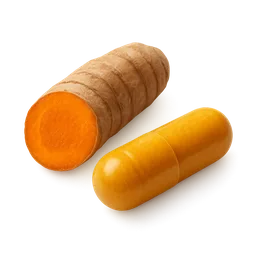
Theracurmin
Best for
Remember more
Likely strong benefit 80–4000 mg/day 1 meta-analysis, n=531 #1 of 42 studied
- 21 papers
- 7 of 61 outcomes
- 5 positive
- 1 severe
Theracurmin offers a likely strong benefit for memory in non-demented adults, while knee-joint benefits are smaller and the strongest signal rests on one long trial.
Risk, worst reported severity
- hepatotoxicity by usnic acid severe
- gastrointestinal events (bloating, diarrhoea, nausea, abdominal pain, constipation) mild
What theracurmin actually does
Memory helps you hold onto information and bring it back when you need it. 40579315
Pain relief can make it easier to move, rest, focus, and get through the day. 35935936 · 36261810 · 40731001 +3
Comfortable joints can make walking, stairs, and everyday movement easier. 35494290 · 35935936 · 36261810 +1
Rheumatoid arthritis causes immune-driven joint inflammation that can bring pain, swelling, stiffness, and fatigue. 35935936
The immune system can drive body-wide inflammation that affects long-term health and how people feel day to day. 35935936
| Outcome | Effect | Evidence | Dose | Time | Rank |
|---|---|---|---|---|---|
| Strong benefits 1 | |||||
| Remember more Likely strong benefit Memory helps you hold onto information and bring it back when you need it. | | 1 meta-analysis 1 papers · n=531 | 80–4000 mg | — | #1 /42 |
| Modest benefits 4 | |||||
| Feel less pain Proven modest benefit Pain relief can make it easier to move, rest, focus, and get through the day. | | 4 meta-analyses 6 papers · n=3.8k | 120–3000 mg | 1–20 wk | — |
| Ease joint pain Proven modest benefit Comfortable joints can make walking, stairs, and everyday movement easier. | | 3 meta-analyses 4 papers · n=3.4k | 120–1500 mg | 20–52 wk | #6 /23 |
| Move with less stiffness Proven modest benefit Stiff joints can make everyday movements feel restricted or uncomfortable. | | 3 meta-analyses 3 papers · n=2.2k | 120–1500 mg | 20 wk | #3 /10 |
| Lower liver enzyme levels Likely modest benefit Liver blood tests can rise when liver cells are injured or bile flow is blocked. | | 1 meta-analysis 2 papers · n=1.0k | 80–3000 mg | 8–16 wk | #1 /39 |
| Early research 1 | |||||
| Ease rheumatoid arthritis symptoms Not enough research Rheumatoid arthritis causes immune-driven joint inflammation that can bring pain, swelling, stiffness, and fatigue. | | 1 meta-analysis 1 papers · n=275 | 120–1500 mg | 20 wk | #1 /7 |
| Safety signals 1 | |||||
| Lower systemic inflammation Likely somewhat harmful The immune system can drive body-wide inflammation that affects long-term health and how people feel day to day. | | 1 meta-analysis 1 papers · n=256 | 120–1500 mg | 20 wk | #4 /83 |
Effect tiers come from native-unit MCID where available, Cohen's d otherwise.
Dose, timing & forms
How much
For memory, the key long-term trial used 90 mg twice daily of Theracurmin for 18 months, rather than a huge one-time turmeric dose.1 Joint studies have used lower daily amounts of this concentrated formulation over weeks, with modest changes in pain and stiffness rather than a dramatic overnight shift.2 Product labels can look confusing because they list the formulation weight, not the curcumin amount in a spoonful of culinary turmeric.
When and how long
Take Theracurmin every day and build it into a routine you can actually keep. The memory protocol split the daily amount into morning and evening doses, while the knee study used a sustained daily regimen for 8 weeks.12 Taking it with a meal is a practical choice if it bothers your stomach, especially because nausea, bloating, and reflux-type symptoms can occur.
Forms & standardisation
Look specifically for the name Theracurmin, not simply "turmeric" or generic "curcumin." Its clinical rationale is the small-particle dispersion technology, which produced substantially greater circulating curcumin than standard curcumin powder in pharmacokinetic testing.3 Do not assume that a different curcumin extract delivers the same exposure or matches the memory and joint trial results.12
Adverse events and drug interactions
Safety events
What this is and how it works
- One study (n=531) reported improved memory-related outcomes; no numerical effect size or MCID comparison is provided.1
- The reviewed evidence spans 21 papers and 61 outcomes, including knee osteoarthritis and brain-health measures.
- The strongest memory signal comes from one long trial in non-demented adults.1
Theracurmin is a specific, highly absorbable form of curcumin, the bright yellow plant compound in turmeric. It uses tiny dispersed curcumin particles so the compound mixes more effectively after you take it, rather than mostly passing through unabsorbed.3
Curcumin interacts with several cell signaling switches involved in inflammation and oxidative stress, while Theracurmin's small-particle design increases how much curcumin reaches circulation.3 Picture ordinary curcumin as clumps of cocoa powder floating on milk, while Theracurmin breaks those clumps into finer particles that mix in more completely.3 In the 18-month memory trial, this more available form tracked with better memory performance and changes in brain measures linked with aging.1
Bottom line
Theracurmin is most interesting if you want a well-absorbed curcumin product and are willing to take it consistently for months. The memory finding is compelling but rests heavily on one long trial, while joint benefits look real but small.12 Skip the hype if you expect fast, dramatic pain relief, and stop or seek clinical advice if it triggers persistent digestive symptoms.
Common questions
What is Theracurmin used for?
Is Theracurmin the same as turmeric?
How long does Theracurmin take to work?
Does Theracurmin help rheumatoid arthritis?
Sources
Sources
- 1. Memory and Brain Amyloid and Tau Effects of a Bioavailable Form of Curcumin in Non-Demented Adults: A Double-Blind, Placebo-Controlled 18-Month Trial (2018) ↑
- 2. Efficacy and Safety of Highly Bioavailable Curcumin Derivative Theracurmin in Patients With Knee Osteoarthritis: A Randomized, Double-Blind, Placebo-Controlled, Prospective Study (2014) ↑
- 3. Innovative Preparation of Curcumin for Improved Oral Bioavailability (2011) ↑
Generated August 27, 2026
Related