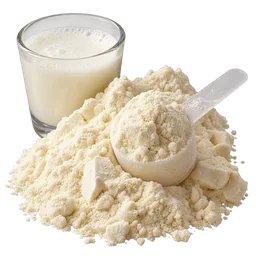
Whey Protein
Best for
Build more muscle
Likely benefit 1–43 weeks 8 meta-analyses, n=8k #3 of 37 studied
- 58 papers
- 3 of 121 outcomes
- 3 positive
- 2 major interactions
Whey protein likely benefits muscle growth and preservation, especially alongside resistance training, with modest gains rather than dramatic changes from the powder alone.
Median effective dose, most-studied outcomes
- Build muscle size 35 g 1–43 wk
- Increase everyday strength 35 g 1–43 wk
Risk, worst reported severity
- hydronephrosis
- tubular regeneration
- tenofovir disoproxil fumarate major
- emtricitabine major
What whey protein actually does
| Outcome | Effect | Evidence | Dose | Time | Rank |
|---|---|---|---|---|---|
| Clear benefits 1 | |||||
| Build more muscle Likely benefit More muscle can support strength, movement, and the physical changes you train for. | | 8 meta-analyses 23 papers · n=8.0k | — | 1–43 wk | #3 /37 |
| Modest benefits 1 | |||||
| Get stronger Proven modest benefit Strength helps your muscles produce more force for lifting, carrying, and daily movement. | | 6 meta-analyses 14 papers · n=8.0k | — | 1–43 wk | #1 /41 |
| Early research 1 | |||||
| Recover better after exercise Barely detectable Recovery helps your body feel ready for the next training session after hard exercise. | | 1 meta-analysis 7 papers · n=386 | — | 1–2 wk | — |
Effect tiers come from native-unit MCID where available, Cohen's d otherwise.
Dose, timing & forms
How much
For building muscle size, the most useful real-world target is a roughly 35 g serving of whey alongside regular resistance training. Trials span a wide range of intakes and run from about 1 to 43 weeks, but the evidence shows that protein adds a modest extra benefit to a solid training plan rather than transforming results overnight.12 Strength gains follow the same pattern: lifting does the heavy lifting, and supplemental protein adds a smaller edge.1
When and how long
Take whey on training days whenever it helps you consistently reach your daily protein target. Taking it after training makes practical sense because whey raises muscle protein building after exercise, but the research does not show that a narrow post-workout deadline decides your results.34 Use a shake between meals, with a meal, or after training based on appetite and routine, then stick with that routine for weeks rather than treating it as an occasional recovery fix.14
Forms & standardisation
The muscle studies most often use whey drinks, including concentrate, isolate, and hydrolyzed whey, rather than proving one format wins for everyone.12 Look for a product that clearly lists grams of protein per serving and an ingredient list you tolerate. Isolate generally suits people who want less lactose or fat, while concentrate often offers a simpler, less processed option, but matching protein intake matters more than chasing a premium label.1
Studied range, by outcome
| Outcome | Studied range | Median effective | Duration | Evidence |
|---|---|---|---|---|
| Build muscle size | 9.6–80 g | 35 g | 1–43 wk | 16 papers 13 sig. endpoints |
| Increase everyday strength | — | 35 g | 1–43 wk | 14 papers 17 sig. endpoints |
| Preserve fat-free mass | 0.24–1.28 g/kg | — | 4–8 wk | 4 papers |
| Restore strength after exercise | 900 mg/kg/day | — | 1 wk | 3 papers |
| Preserve lean tissue | 20 g | — | — | 1 paper |
Adverse events and drug interactions
Safety events
Drug interactions
Recommended Whey Protein products
Real products that dose Whey Protein where the research does, in a clean formulation, from brands we've audited. We only list ones we'd stand behind.
-

BulkSupplements.com
Whey Protein (Grass-Fed)
Well dosed 30 Gram(s)/day A formulaBrand audit 54/100
-

NutraBio
Clear Whey Protein Isolate Pineapple Splash
Well dosed 23.64 Gram(s)/day A formulaBrand audit 90/100
-

NutraBio
100% Whey Protein Isolate Unflavored
Well dosed 84.57 Gram(s)/day A formulaBrand audit 90/100
-

Source Naturals
True Whey
Well dosed 11 Gram(s)/day A formulaBrand audit 73/100
-

Thorne
Whey Protein Isolate Chocolate Flavored
Well dosed 25 Gram(s)/day B formulaBrand audit 79/100
-

Thorne
Whey Protein Isolate Vanilla Flavored
Well dosed 25 Gram(s)/day B formulaBrand audit 79/100
Chosen for adequate Whey Protein dosing vs. the studied range, a clean formulation (grade A–C), and independent brand-quality audits. Not sponsored.
What this is and how it works
- Across 23 studies (n=7,992), whey protein improved muscle-building outcomes across 77 measured endpoints.1
- The evidence spans 58 reviewed papers and 121 outcomes, with strongest support for resistance-trained adults.1
- Benefits depend on sufficient total protein intake and regular resistance exercise, not whey protein alone.2
Whey is the protein-rich liquid portion of milk that separates during cheese making. Manufacturers filter and dry it into powder, creating a fast, convenient source of complete protein with all essential amino acids.3
Bottom line
Whey protein makes sense if you lift regularly and struggle to get enough protein from food, especially if a shake makes consistency easy. Expect modest extra muscle and strength gains over weeks of training, not dramatic changes from the powder alone.12 Skip the casual self-experiment if you use prescription medicines with known interaction concerns or have kidney-related medical issues, and check with your clinician first.
Common questions
Does whey protein build muscle without lifting weights?
How much whey protein should you take after a workout?
Is whey isolate better than whey concentrate for muscle growth?
Is whey protein useful for strength?
Sources
Sources
- 1. A systematic review, meta-analysis and meta-regression of the effect of protein supplementation on resistance training-induced gains in muscle mass and strength in healthy adults (2018) ↑
- 2. Protein supplementation augments the adaptive response of skeletal muscle to resistance-type exercise training: a meta-analysis (2012) ↑
- 3. Ingestion of whey hydrolysate, casein, or soy protein isolate: effects on mixed muscle protein synthesis at rest and following resistance exercise in young men (2009) ↑
- 4. The effect of protein timing on muscle strength and hypertrophy: a meta-analysis (2013) ↑
Generated August 27, 2026
Related
More evidence for Whey Protein
Evidence map
Metabolic health
NewMetabolic health: evidence map across 82 supplements
Evidence coverage map
Jul 30, 2026
Ingredient evidence
Ingredient evidence
NewCreatine
All scored outcomes
Aug 27, 2026
Ingredient evidence
Ingredient evidence
NewMilk Protein
All scored outcomes
Aug 27, 2026
Ingredient evidence
Ingredient evidence
NewArginine
All scored outcomes
Aug 27, 2026
Ingredient evidence
Ingredient evidence
NewAshwagandha
All scored outcomes
Aug 27, 2026
Ingredient evidence
Ingredient evidence
NewBCAAs (Branched-Chain Amino Acids)
All scored outcomes
Aug 27, 2026