New Spirulina Published Apr 19, 2026
From Aztec "Cheese" to Space Smoothies: What Spirulina Really Does
Better blood sugar and cholesterol control, compact protein and nutrition, and natural anti-inflammatory support
Evidence summary
Spirulina is a blue-green microalga whose best-supported effect is modest metabolic improvement, especially lower fasting glucose and better lipid profiles.
- In one 3-month randomized trial, 2 g/day spirulina lowered HbA1c about 1.4% and triglycerides versus placebo.3
- Most human studies use about 2 g/day, including type 2 diabetes, rhinitis, and athlete-recovery settings.
- Meta-analyses still report mixed HbA1c results, keeping diabetes benefits smaller than the fasting-glucose signal.2
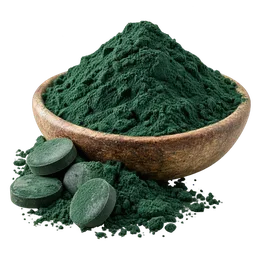
In a bustling market five centuries ago, a soldier tasted green cakes that "taste like cheese." Today, astronauts sip green smoothies brewed from the same organism aboard the International Space Station. What happened in between—and what can spirulina actually do for you?
The lake that fed empires—and an idea that went to space
Bernal Díaz del Castillo, marching into Tenochtitlan in the 1520s, noticed vendors selling "little loaves.. made out of a sort of slime.. which taste like cheese." He was watching Aztecs trade cakes of spirulina skimmed from Lake Texcoco—a food so ordinary it barely merited a line in his chronicle, yet so concentrated that a mouthful colored with chlorophyll could stand in for a meal.9 Half a world away, Kanembu women around Lake Chad still dry spirulina into dihé squares to thicken sauces—an elegant, low-tech protein strategy described by FAO researchers as part of a living food system.10 Centuries later, engineers would look at the same microalga and see not just food, but life support. In 2018, ESA reported that its photobioreactors grew spirulina in orbit, recycling carbon dioxide into oxygen and edible biomass: "The green smoothie-like product was safe to add to astronaut diets as a source of protein."7 NASA scientists have likewise explored spirulina for closed ecological life-support—tiny coils of life that breathe out oxygen as they grow.8
What's inside the green?
Spirulina (more precisely, Arthrospira) is a protein-rich, iron-bearing microalga whose signature blue pigment, phycocyanin, behaves like a fire blanket for the body's chemistry—soaking up "sparks" of oxidation and dialing down inflammatory signals. That chemistry has inspired a wave of clinical trials—not miracle-cure hype, but measurable effects in defined groups.
- In people with metabolic syndrome or type 2 diabetes, pooled analyses of randomized trials show spirulina can lower fasting glucose and improve cholesterol patterns (downward nudges in total and LDL cholesterol; small increases in HDL). Effects on longer-term HbA1c are mixed overall.12
- A recent add-on, double-blind trial in patients on metformin found that 2 g/day of spirulina for 3 months reduced HbA1c by about 1.4 percentage points and improved fasting glucose and triglycerides—promising, though from a single center and modest sample.3
Think of it this way: spirulina doesn't "hack" your metabolism; it nudges several dials at once—blood fats, fasting sugar, and perhaps the low-grade inflammation that keeps those dials stuck.
Stories from the field: when food must work like medicine
- In Kisantu, Democratic Republic of the Congo, malnourished children given 10 g/day spirulina stirred into their regular meals gained weight faster, and anemia markers improved significantly within 30 days compared with controls. It wasn't a stand-alone cure; it was a dense ingredient that moved numbers in the right direction, quickly.4
- In Burkina Faso, clinicians saw undernourished, HIV-infected and HIV-negative children gain weight and reduce anemia over 8 weeks when spirulina was layered onto standard diets—again, a food pressed into therapeutic service.5
These aren't polished lifestyle stories. They are pragmatic, sometimes messy, attempts to add protein and micronutrients where they're scarce, echoing the ingenuity of the Kanembu dihé and Aztec markets.
The surprise chapter: a detox puzzle from Bangladesh
Arsenic-tainted wells left villages in Bangladesh with skin lesions and systemic toxicity. With no specific antidote, researchers tried an unusual pairing: spirulina extract plus zinc versus placebo for 16 weeks. The spirulina-zinc group showed greater improvement in arsenic-related skin changes and reductions in arsenic in hair and urine.6 One small trial doesn't make a guideline, but it's a striking example of microalgae stepping outside the smoothie bar.
Allergies, athletes, and the "blue switch"
Allergic rhinitis is an immune over-reaction. In a double-blind study, 2 g/day spirulina reduced IL-4—a messenger that drives IgE-type allergy—by about a third in allergic patients' immune cells, hinting at a calmer "default setting."14 For athletes, spirulina's pigments may act like shock absorbers. Elite rugby players who supplemented through a season blunted spikes in lipid peroxidation and muscle-damage markers after brutal matches, recovering faster on laboratory measures.15 Small trials also report subtle changes in heart rate and oxygen economy with short courses, more like fine-tuning than turbo-boosting.
"The beauty of the Arthrospira microorganism is that it is edible if pure." —European Space Agency, on flying a spirulina bioreactor and serving a safe "green smoothie" in orbit7 "Little loaves.. from a sort of slime.. which taste like cheese." —Bernal Díaz del Castillo, describing Aztec spirulina cakes in the Tlatelolco market, 1520s9
What spirulina is not
The myth-making around spirulina has been as fertile as the lakes that grow it. FAO chronicled the real, valuable traditions around dihé; it did not anoint spirulina as a magic cure. Modern reviews and meta-analyses point to promising benefits for metabolic health, certain inflammatory conditions, and nutrition support—tempered by variability in study quality and dose.1212 And there's a hard, modern caveat: purity. Spirulina itself doesn't make liver-damaging microcystin toxins, but other cyanobacteria in open ponds do. FDA has documented recalls when related algae contaminated products; independent researchers recently found microcystins and opportunistic bacteria across some retail items.1113 France's ANSES advises buying from trustworthy, controlled producers and reminds vegans that spirulina's "B12" is mostly inactive—don't count on it for that vitamin.12
If you're curious to try it
- Doses used in trials often range from 1–3 g/day, sometimes up to 8 g/day, taken with food. In diabetes and dyslipidemia trials, 2 g/day for 8–12 weeks is common; in immune or allergy studies, 2 g/day for 12 weeks; nutrition-support programs use food-like amounts (e.g., 10 g/day) under supervision.23414
- Look for third-party testing and cultivation in controlled systems; avoid wild-harvested cyanobacteria mixes. This is where the astronaut lesson comes home: purity matters.1112
- Who tends to benefit? People aiming to modestly improve fasting glucose or cholesterol; those needing compact protein and iron in constrained diets; athletes managing recovery stress; and, in clinical contexts, groups facing undernutrition or inflammatory bowel disease where small RCTs suggest improved iron status and quality-of-life markers.1241516
- Who should be cautious or avoid it? If you have autoimmune disease or are on immune-modulating drugs, if you use anticoagulants, or if you have phenylketonuria, discuss alternatives; and everyone should prioritize tested, toxin-screened products.1211
Why this old-new food endures
Spirulina's story is less about miracles than fit: it fits alkaline lakes and backyard tanks; it fits a clinic's recipe for calorie-and-micronutrient density; it fits a space capsule where oxygen and protein must cycle. From Aztec "cheese" to space smoothies, the green thread is the same: a tiny coil of life that turns light and minerals into edible resilience. Used wisely—pure, appropriately dosed, and for the right problems—spirulina earns its place not as a panacea, but as a practical ally.710
Key takeaways
What to walk away with
- 01
Promising metabolic effects: meta-analyses show reductions in fasting glucose and improved lipid profiles, though HbA1c results are mixed.
- 02
Useful clinical dose range: many studies use about 2 g/day for 8–12 weeks; supervised, food-like doses (e.g., 10 g/day) are reserved for specific programs.
- 03
Practical use: take with meals to mellow its ocean-green taste and reduce queasiness; treat it as a concentrated garnish, not a meal replacement.
- 04
Who may benefit: people targeting modest improvements in glucose or cholesterol, athletes supporting recovery, and those needing compact protein and iron.
- 05
Safety notes: don't rely on spirulina for vegan B12; choose products that disclose microcystin testing and consult a clinician if on glucose-lowering, immune-modulating, or anticoagulant therapy.
Effect timeline
When to expect what
- Immediate
- Yes (some exercise/recovery markers within 1–2 weeks in small trials)
- Peak
- 4–12 weeks for nutrition and metabolic outcomes
- Duration needed
- 8–12 weeks minimum for metabolic changes; longer or ongoing for nutrition support
- Wears off
- Gradually over weeks after stopping; data limited
Research trajectory
What the studies actually show
-
Meta-analyses show spirulina lowers fasting glucose and improves lipid profiles; HbA1c findings are mixed. 1
Systematic syntheses across RCTs in metabolic syndrome and type 2 diabetes.
Supports use as an adjunct for modest metabolic improvements.
-
Add-on 2 g/day spirulina for 3 months reduced HbA1c (~1.4%) and triglycerides versus placebo in uncontrolled T2D on metformin. 3
Randomized, double-blind trial tracking glycemic endpoints at 30/60/90 days.
Signals potential clinical relevance when layered on standard care.
-
In allergic rhinitis, 2 g/day spirulina reduced IL-4 production by ~32% in immune cells. 14
Double-blind crossover trial assessing cytokine output from patients' PBMCs.
Mechanistic clue for symptom relief in atopic conditions.
-
Season-long spirulina use by elite rugby players blunted exercise-induced lipid peroxidation and muscle-damage markers. 15
Controlled study measuring F2-isoprostanes, CRP, and CK around matches.
Suggests recovery benefits under high oxidative load.
Human trials
What real trials found
-
Therapeutic feeding center in Kisantu, DRC added 10 g/day spirulina to children's meals for 30 days. 4
- Outcome
- Greater weight gain and improved hemoglobin/albumin versus controls within one month.
- Why it matters
- Shows spirulina as dense nutrition in real-world malnutrition care.
- Source
- Int J Pediatr 2016; open-access clinical study.
-
Burkina Faso rehabilitation program for undernourished, HIV-infected and HIV-negative children using spirulina with traditional meals. 5
- Outcome
- Daily weight gain and reduced anemia over 8 weeks, especially in HIV-negative children.
- Why it matters
- Food-as-therapy use in resource-limited settings.
- Source
- Nutr J 2005 clinical report.
-
Bangladesh randomized, placebo-controlled trial of spirulina extract + zinc for chronic arsenic poisoning over 16 weeks. 6
- Outcome
- Improved skin lesions and lowered arsenic in hair/urine vs placebo.
- Why it matters
- Unexpected application beyond nutrition; hypothesis-generating.
- Source
- Clin Toxicol 2006 RCT.
Expert insights
Voices in the field
The green smoothie-like product was safe to add to astronaut diets as a source of protein. 7
Little loaves... made out of a sort of slime... which taste like cheese. 9
Practical guidance
Putting it to use
Who may benefit
People aiming to modestly improve fasting glucose or cholesterol; athletes managing recovery; those needing compact protein and iron in constrained diets; and patients in supervised programs for undernutrition or ulcerative colitis where small RCTs suggest improved iron status and quality of life.
Who should avoid
Autoimmune disorders (potential immune stimulation), phenylketonuria (contains phenylalanine), and those on anticoagulants unless medically supervised.
Dosing
Common trial doses are 1–3 g/day; metabolic studies often use ~2 g/day for 8–12 weeks; therapeutic feeding programs use food-like doses (e.g., 10 g/day) under supervision.
Timing
Take with meals to soften its ocean-green taste and reduce queasiness; think of it as a concentrated garnish rather than a meal replacement.
Quality
Prefer cultivated Arthrospira grown in controlled systems with third-party tests for microcystins and heavy metals; avoid wild cyanobacteria blends marketed as 'blue-green algae.'
Cautions
Not a reliable source of vitamin B12 for vegans; choose products that disclose microcystin testing; discuss use if you're on glucose-lowering, immune-modulating, or anticoagulant therapy.
A closing thought
A food that once filled market baskets and now spins in zero-g reminds us that progress isn't always about inventing new things—it's often about purifying, contextualizing, and using old things well. Spirulina won't replace wisdom, but it can concentrate it.
Frequently asked
Common questions
What does spirulina actually help with?
How much spirulina should I take—and for how long?
When should I take spirulina for best results?
Who should be cautious or avoid spirulina?
What quality markers should I look for?
Is spirulina good for iron or recovery needs?
Related
More on this supplement
Pulled from across the site — rankings, comparisons, combinations, and reviews where this supplement shows up.
Ingredient evidence
Ingredient evidence
NewSpirulina
All scored outcomes
Aug 27, 2026
Ranking
High LDL and Total Cholesterol
NewBest Supplements to Lower LDL and Total Cholesterol
Evidence ranking
Apr 4, 2026
Ranking
High Blood Pressure
NewBest Supplements for Blood Pressure, Ranked by Clinical Evidence
Evidence ranking
Apr 4, 2026
Evidence map
Metabolic health
NewMetabolic health: evidence map across 82 supplements
Evidence coverage map
Jul 30, 2026
Sources
- 1. Spirulina and metabolic syndrome: systematic review and meta-analysis (2019)
- 2. Effect of spirulina on type 2 diabetes: systematic review and meta-analysis (2021)
- 3. Add-on spirulina in inadequately controlled type 2 diabetes: randomized, double-blind, placebo-controlled trial (2022)
- 4. Spirulina supplements improved nutritional status of undernourished children: Kisantu, DRC (2016)
- 5. Nutrition rehabilitation of HIV-infected and HIV-negative undernourished children utilizing spirulina (2005)
- 6. Spirulina extract plus zinc for chronic arsenic poisoning: randomized placebo-controlled study (2006)
- 7. ESA: Green smoothies in space (Artemiss spirulina photobioreactor on the ISS) (2018)
- 8. NASA: Food production and gas exchange system using spirulina for CELSS (1987)
- 9. Mexicolore: Aztec 'tecuitlatl' (spirulina) and Díaz del Castillo quote (2009)
- 10. FAO: The Future is an Ancient Lake—Atroun and Dihé (Lake Chad) (2004)
- 11. FDA: Blue-Green Algae Products and Microcystins (2020)
- 12. ANSES: Spirulina supplements—choose trustworthy supply; not a B12 source (2017)
- 13. Microbiota and cyanotoxin content of retail spirulina supplements (2023)
- 14. Spirulina in allergic rhinitis: randomized double-blind study on cytokines (2005)
- 15. Spirulina supplementation in elite rugby players: oxidative stress and recovery (2022)
- 16. Effects of spirulina in ulcerative colitis: double-blind RCT (2024)
1,045 words · 16 sources · Spirulina