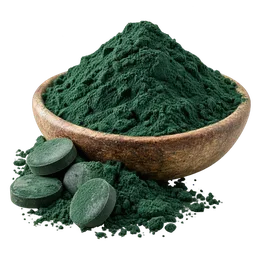
Spirulina
What the trials found
Spirulina does not have one reliably established benefit across varied outcomes; evidence is strongest for antioxidant and immune-related measures, while practical health effects remain uncertain.
- 45 papers
- 0 of 125 outcomes
- 1 severe
Median effective dose, most-studied outcomes
- Support overall antioxidant capacity 1,000 mg 1–12 wk
Risk, worst reported severity
- anaphylaxis severe
- nausea mild
- dexamethasone moderate
- cyclophosphamide moderate
Dose, timing & forms
How much
For overall antioxidant support, human studies examined 1,000 to 5,000 mg daily of spirulina, with 1,000 mg daily representing the median effective amount among the reviewed trials. The signal is promising but uneven: only half of the antioxidant-focused studies reported a statistically significant result, so higher doses do not guarantee a stronger outcome.1
When and how long
Consistency matters more than clock time. Antioxidant-focused protocols used spirulina daily, commonly for roughly 10 weeks, rather than as an occasional pre-workout or recovery supplement.1 Taking it with a meal is a practical choice if it causes nausea or bloating, although the trial evidence does not establish a superior time of day.
Forms & standardisation
Most human research uses dried spirulina powder or tablets, rather than an isolated phycocyanin product. Look for a product that identifies the species as Arthrospira platensis or Arthrospira maxima and provides clear third-party contaminant testing, since algae products can vary in purity. The antioxidant evidence applies to whole spirulina preparations, not automatically to every highly concentrated pigment extract.1
Studied range, by outcome
| Outcome | Studied range | Median effective | Duration | Evidence |
|---|---|---|---|---|
| Support overall antioxidant capacity | 1,000–5,000 mg | 1,000 mg | 1–12 wk | 6 papers 3 sig. endpoints |
Adverse events and drug interactions
Safety events
Drug interactions
Recommended Spirulina products
Real products that dose Spirulina where the research does, in a clean formulation, from brands we've audited. We only list ones we'd stand behind.
-

BulkSupplements.com
Spirulina Powder (California Grown)
Well dosed 9 Gram(s)/day A formulaBrand audit 54/100
-

BulkSupplements.com
Spirulina Powder
Well dosed 9 Gram(s)/day A formulaBrand audit 54/100
-

Life Extension
X-R Shield
Well dosed 4,005 mg/day B formulaBrand audit 90/100
-

AN Amazing Nutrition Amazing Formulas
Spirulina
Well dosed 8 Gram(s)/day A formula -

Herbal Terra
Spirulina Sugar Free Alcohol Free
Well dosed 4,624 mg/day A formula -

Hawaii Pharm
Spirulina Alcohol Free
Well dosed 4,624 mg/day A formula
Chosen for adequate Spirulina dosing vs. the studied range, a clean formulation (grade A–C), and independent brand-quality audits. Not sponsored.
What this is and how it works
- Across 45 reviewed papers spanning 125 outcomes, reported benefits varied across antioxidant and performance measures.1
- Human research includes antioxidant, exercise, and immune outcomes across diverse doses and participant groups.
- Immune-related findings include elderly subjects, limiting generalization to younger healthy adults.2
Spirulina is a blue-green microorganism grown in water, then dried into powder, tablets, or capsules. Its vivid color comes partly from phycocyanin, a blue pigment-protein that gives spirulina much of its scientific interest.1
Your cells constantly handle reactive molecules created by normal metabolism, like sparks flying from a busy kitchen stove. Spirulina's pigments and nutrients appear to reinforce the body's antioxidant cleanup crew, including protective enzyme activity, which can shift blood markers of oxidative stress in some human studies.1
Bottom line
Spirulina fits people who want a food-derived supplement and are comfortable with an antioxidant benefit that looks plausible, not guaranteed. Give a consistent daily routine several weeks before judging it. Skip self-experimentation and seek clinical advice if you have had a severe algae allergy or use medicines that affect immune activity.
Common questions
What does spirulina actually do in the body?
How long does spirulina take to work?
Is spirulina worth taking for antioxidants?
Sources
Sources
Generated August 27, 2026
Related
More evidence for Spirulina
Evidence guide
Spirulina
NewFrom Aztec "Cheese" to Space Smoothies: What Spirulina Really Does
Evidence guide
Apr 19, 2026
Ranking
High LDL and Total Cholesterol
NewBest Supplements to Lower LDL and Total Cholesterol
Evidence ranking
Apr 4, 2026
Ranking
High Blood Pressure
NewBest Supplements for Blood Pressure, Ranked by Clinical Evidence
Evidence ranking
Apr 4, 2026
Evidence map
Metabolic health
NewMetabolic health: evidence map across 82 supplements
Evidence coverage map
Jul 30, 2026
Ingredient evidence
Ingredient evidence
NewAnthocyanidins
All scored outcomes
Aug 27, 2026
Ingredient evidence
Ingredient evidence
NewAstaxanthin
All scored outcomes
Aug 27, 2026