New L-Leucine Published Mar 4, 2026
The White Crystal That Flips a Muscle Switch—and the Paradox It Reveals
Better muscle building after workouts, improved strength gains, and enhanced protein utilization
Evidence summary
Leucine-rich supplements improve muscle strength and physical performance in sarcopenic older adults, with the clearest gains coming from combination formulas rather than leucine alone.
- Across 17 randomized trials, leucine-rich supplementation improved sarcopenia-related measures in older adults 7.
- Trials focused on sarcopenic older adults, short-term bed rest, and supplement blends that paired leucine with protein or vitamin D.
- Leucine alone often underperformed, and the metabolic paradox extends beyond muscle into insulin resistance and animal lifespan studies.
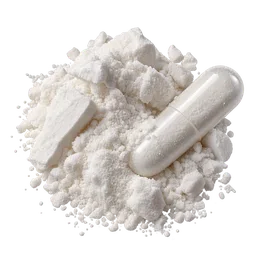
A French chemist once boiled wool and "petrified cheese" and found a gleaming white crystal. Two centuries later, that same crystal—L-leucine—can tell your muscles it's time to build. But here's the twist: while leucine can kick-start growth, diets overloaded with the same family of amino acids may, in other contexts, be tied to metabolic trouble or even longer life when restricted in animals. What's going on?12
From petrified cheese to a modern trigger
Henri Braconnot's 1820s experiments teased a white substance from animal tissues and old cheese, a finding later named "leucine," from the Greek leukos, meaning white.12 That crystal would become the lead actor in one of nutrition's most compelling stories: how a single amino acid can act like a green light for muscle building.
You are what you just ate—literally
In a now-famous set of studies, Dutch researchers fed volunteers protein whose amino acids had been traced all the way from a specially labeled cow. Within hours of a meal, more than half of those amino acids were circulating, and a meaningful share was being stitched into new muscle—evidence that dinner can become biceps by lunchtime.34 Think of leucine as the foreman who arrives on site and shouts, "Build!" The workers (the other amino acids) are already milling about, but until the foreman shows up, construction is slow.
"Flip the switch," say the experts
Protein researchers have described leucine's role in refreshingly plain language. "It's like turning on the light switch for the protein synthesis process," says Stuart Phillips, PhD. He adds that for older or inactive people, you may need more leucine to get the same effect—more like a dimmer switch turned higher.5 Don Layman, PhD, frames it as a threshold: roughly 3 grams of leucine at a meal—about what's in a typical scoop of whey—seems to be the signal that tells muscle the meal was substantial enough to build with.616
What trials in real people show
Here's where the story gets practical—and nuanced.
Older adults with sarcopenia: a meta-analysis of 17 randomized trials found that leucine alone didn't reliably move lean mass or strength. But when leucine was part of a combined plan—including vitamin D—it modestly improved handgrip strength and gait speed.7 Another review focused on leucine-rich proteins reported benefits across strength, mass, and performance in sarcopenic adults, underscoring that context matters.8
Institutionalized seniors: in a 13-week, placebo-controlled trial, 6 g/day of leucine improved walking time and respiratory muscle strength—subtle but meaningful gains for people who struggle with daily mobility.9
Bed rest and recovery: in middle-aged and older adults forced into short-term bed rest, leucine partly protected leg lean mass and helped maintain muscle quality, though it didn't solve everything—function still dipped without movement.1011
After hospitalization: pairing resistance training with a whey protein drink enriched with ~3 g leucine helped post-hospitalized older patients regain capacity more effectively than training alone.12
The thread running through these studies is simple: leucine works best not as a solo artist but as the opening chord in a full arrangement—adequate total protein, key nutrients (often vitamin D), and, most importantly, resistance exercise.
The paradox of plenty
If leucine can "flip the switch," why do some studies link higher branched-chain amino acid (BCAA) levels to insulin resistance? Observational research finds that people who eat more BCAAs are more likely to meet criteria for insulin resistance, but genetic analyses suggest the arrow mostly points the other way: insulin resistance seems to drive BCAA build-up in the blood, not vice versa.1314 Meanwhile, animal studies show another twist: restricting BCAAs—or specifically isoleucine—can extend lifespan and improve metabolic health in mice.1516 Together these findings tell us leucine is a tool. Use it to hit a per-meal signal inside an overall balanced diet and active life, not as a free-floating megadose.
How to make leucine work for you
Aim for roughly 2.5–3 g leucine at protein-containing meals—enough to ring the "build" bell. A 32-gram scoop of whey provides about 2.5 g; hard cheeses like Parmesan pack ~4 g per 100 g; many meats and soy foods can get you there as part of a 25–40 g protein meal.1617
Distribute protein: older adults often respond best when breakfast and dinner each clear the threshold that Layman describes.6
Pair with training: resistance exercise is the construction crew; leucine is the foreman. Without workers, shouting doesn't raise a house.512
Consider combos: in older adults, leucine combined with vitamin D has shown small but significant gains in strength and walking speed.7
Know the baseline: typical adult leucine requirements sit near 42 mg/kg/day from total diet—easily met with balanced protein intake.2
Safety notes from history and clinic
Two special cases deserve attention. People with maple syrup urine disease (MSUD), a rare disorder of BCAA breakdown, must strictly limit leucine and should not use leucine supplements.20 And in regions where sorghum or certain maize varieties dominate the diet, historically high leucine intakes relative to other nutrients have been linked to pellagra-like niacin deficiency—a reminder that balance matters.19
The take-home
Leucine is less a magic powder than a timely message. Hit an effective dose at key meals, keep lifting something heavy, and let the rest of your diet carry the melody. Used that way, a humble white crystal discovered in old cheese still speaks clearly to 21st-century muscles—"build now."345
Key takeaways
What to walk away with
- 01
Leucine acts as the "on" switch for muscle protein synthesis, with a practical per-meal threshold around ~3 g.
- 02
Most meals with ~25–40 g high-quality protein naturally deliver ~2.5–3 g leucine; whey, hard cheeses, meats, and soy isolates are reliable sources.
- 03
Benefits are most evident in older or immobilized adults: leucine-rich supplements support strength, mass, and performance; short bed-rest periods show lean-mass protection.
- 04
Leucine alone can underperform; paired with vitamin D, mobility metrics like handgrip and gait speed improve in older adults.
- 05
Timing matters: emphasize a leucine-aware breakfast after an overnight fast and a robust protein dinner post-training.
- 06
Use with care: avoid in maple syrup urine disease; extremely unbalanced high-leucine staple diets can contribute to problems when niacin/tryptophan are low.
Effect timeline
When to expect what
- Immediate
- Within hours (muscle protein synthesis rises after a leucine-rich meal)
- Peak
- 6-12 weeks (strength/performance changes in trials)
- Duration needed
- Ongoing with training; many studies run 8–13+ weeks
- Wears off
- Acute synthesis signal fades within hours; functional gains decline over weeks if intake/training stop
Research trajectory
What the studies actually show
-
Leucine-rich supplements can improve strength, mass, and performance in sarcopenic older adults. 8
Systematic review focusing on leucine-rich proteins in diagnosed sarcopenia.
Supports use in frailty when embedded in complete nutrition.
-
Leucine alone often underperforms, but combined with vitamin D it improves handgrip and gait speed. 7
Meta-analysis of 17 RCTs in older adults.
Signals that combinations matter more than isolated leucine.
-
Short-term bed rest trials show leucine can blunt lean mass losses and maintain muscle quality. 10
Randomized trials in middle-aged/older adults during 7–14 days of inactivity.
Practical for hospital stays or injury recovery planning.
-
Insulin resistance likely raises circulating BCAAs rather than the reverse; BCAA restriction extends lifespan in mice. 13
Mendelian randomization in humans plus lifespan studies in rodents.
Reconciles epidemiology with mechanism and cautions against overinterpreting causality.
Human trials
What real trials found
-
Institutionalized older adults took 6 g/day leucine for 13 weeks. 9
- Outcome
- Improved walking time and expiratory muscle strength vs. placebo; well tolerated.
- Why it matters
- Shows real-world functional gains in frail seniors.
- Source
- Cauli et al., randomized, placebo-controlled clinical trial
-
Middle-aged adults on 14-day bed rest received leucine with meals (0.06 g/kg/meal). 10
- Outcome
- Partially preserved leg lean mass and muscle quality; limited effect on some functions.
- Why it matters
- Demonstrates protective effects during enforced inactivity.
- Source
- Paddon-Jones/Fry group, randomized, double-blind trial
-
Post-hospitalized older adults completed resistance training with/without leucine-enriched whey. 12
- Outcome
- Leucine-enriched whey plus training improved recovery metrics over 12 weeks.
- Why it matters
- Pairs supplementation with the stimulus that makes it work best.
- Source
- J Clin Med trial in Spain (S&F-PROT)
-
Human tracer study following meal amino acids from a labeled cow into human muscle. 4
- Outcome
- ~55% of amino acids entered circulation; significant incorporation into muscle within hours.
- Why it matters
- Vivid, mechanistic evidence that meals rapidly become muscle.
- Source
- PLOS ONE: "Post-Prandial Protein Handling: You Are What You Just Ate"
Expert insights
Voices in the field
"It's like turning on the light switch for the protein synthesis process...people who are inactive or older need more leucine for that process to happen." 5
"There's this threshold around three grams of leucine at a meal...the signal that you just ate enough protein to trigger the process." 6
Practical guidance
Putting it to use
Who may benefit
Adults over 60 targeting strength and mobility; anyone recovering from hospitalization or brief immobilization; athletes seeking to optimize per-meal protein signaling; plant-forward eaters who plan portions to reach the leucine signal.
Who should avoid
Individuals with maple syrup urine disease (MSUD) or on clinician-directed BCAA-restricted diets.
Dosing
Most meals that deliver ~25–40 g of high-quality protein naturally provide ~2.5–3 g leucine—enough to flip the muscle-building signal. A 32 g scoop of whey contains ~2.5 g leucine; hard cheeses (Parmesan) are ~4 g/100 g; meats and soy isolates are solid sources.
Timing
Make breakfast and dinner count. After an overnight fast, muscles are especially attentive to a protein-and-leucine start; match it with a robust protein dinner post-training.
Quality
Whey is fast-digesting and leucine-dense; soy and high-leucine plant proteins also work with slightly larger portions. In older adults, pairing leucine-rich protein with vitamin D and resistance training tends to produce the most consistent gains.
Cautions
People with maple syrup urine disease require medical leucine restriction. Extremely unbalanced, high-leucine staple diets have historically contributed to pellagra where niacin/tryptophan are low—balance matters.
A closing thought
Leucine isn't a promise; it's a vote. Cast it at the right moments, alongside movement and real food, and your body answers with structure, strength, and steadiness.
Frequently asked
Common questions
How much leucine should I aim for at a meal?
When is the best time to prioritize leucine?
Who stands to benefit the most from leucine-focused meals or supplements?
Is leucine alone enough, or should it be combined with other nutrients?
What foods help me reach the leucine threshold?
Are there any cautions with leucine use?
Related
More on this supplement
Pulled from across the site — rankings, comparisons, combinations, and reviews where this supplement shows up.
Sources
- 1. Braconnot, Henri (biography and discoveries)
- 2. Leucine (entry; etymology and RDA) (2025)
- 3. Four Laws of Muscle (van Loon's labeled cow narrative) (2019)
- 4. Post-Prandial Protein Handling: You Are What You Just Ate (PLOS ONE) (2015)
- 5. Protein and healthy aging interview (Stuart Phillips, PhD) (2020)
- 6. Putting Perspective on Protein (Don Layman, PhD) – Transcript (2023)
- 7. Effect of Leucine Supplementation on Sarcopenia-Related Measures in Older Adults: Meta-analysis of 17 RCTs (2022)
- 8. Leucine-rich protein supplements in sarcopenic older adults: Systematic review and meta-analysis (2022)
- 9. Effects of Leucine Administration in Sarcopenia: Randomized, Placebo-controlled Trial (2020)
- 10. Leucine partially protects muscle during bed rest (middle-aged adults) (2016)
- 11. Countering disuse atrophy in older adults with low-volume leucine supplementation (2020)
- 12. Leucine-enriched whey plus resistance training after hospitalization (J Clin Med) (2022)
- 13. Genetic evidence of a causal effect of insulin resistance on BCAA levels (Mendelian randomization) (2017)
- 14. High dietary BCAA intake associated with increased insulin resistance risk (2018)
- 15. Lifelong BCAA restriction has sex-specific lifespan benefits in mice (2021)
- 16. Dietary restriction of isoleucine increases healthspan and lifespan of mice (2023)
- 17. Whey protein amino acid profile (per 32 g serving) (2025)
- 18. USDA values for Parmesan cheese amino acids (per 100 g, shredded) (2025)
- 19. Sorghum and millets in human nutrition: leucine and pellagra
- 20. Maple Syrup Urine Disease – GeneReviews (2023)
1,097 words · 20 sources · L-Leucine