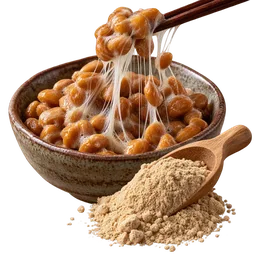
A thousand-year-old breakfast with strings like spider silk is credited by some Japanese elders for "keeping the blood flowing." In the 1980s, a young researcher put that breakfast on a fake blood clot—and watched the knot melt away.
Lunch, a Petri Dish, and a Dissolving Knot
You're in a quiet lab when the surprise happens. A dollop of natto—the sticky, string-pulling fermented soy beloved in Japan—lands on an artificial clot. Hours pass. The clot thins, then vanishes. In 1987, Dr. Hiroyuki Sumi reported a "novel fibrinolytic enzyme" in natto and named it nattokinase, a protein-cutting enzyme that breaks down fibrin, the rope-like mesh that hardens clots. He and colleagues showed the food itself had strong clot-dissolving activity, and that taking nattokinase by mouth could boost the blood's own clot-clearing capacity in animals and early human measures. The folk food suddenly had a molecular protagonist. 1,2
How an Enzyme Becomes a Street Sweeper
Clots aren't just blobs; they're nets. Fibrin strands tangle, trap cells, and can choke off tissues. Your body normally sends a cleanup crew—plasmin and its activators—to snip those strands. Nattokinase appears to help in three practical ways: it can nibble directly at fibrin; it can "flip on" the body's own cleanup by converting a dormant enzyme (prourokinase) into its active form; and it knocks out a traffic cop called PAI-1 that otherwise stalls the cleanup crew. Imagine cutting the net, recruiting more cutters, and taking the brakes off—all at once. Lab work from Japan mapped this by showing nattokinase cleaves and inactivates PAI-1 and enhances tissue plasminogen activator (tPA)–driven clot lysis. 3,4
"Subtilisin NAT [nattokinase].. enhanced tPA-induced fibrin clot lysis.. involving the cleavage and inactivation of active PAI-1." —Urano et al., Journal of Biological Chemistry 3
From Breakfast to Blood Pressure
History is charming; outcomes matter. Two randomized, double-blind human trials—one in North America—found modest drops in blood pressure over eight weeks with oral nattokinase (typically 2,000 FU/day). Systolic and diastolic pressures nudged down by a few points on average, with hints of sex-specific effects and changes in a clot-related protein (von Willebrand factor). A 2024 meta-analysis pooling RCTs concluded that nattokinase "significantly reduced" systolic and diastolic blood pressure compared with placebo, while noting little consistent effect on most blood lipids. 5,6,7
"This study further supports that nattokinase can be used as an effective adjunctive therapy for hypertension." —Systematic Review & Meta-analysis, 2024 7
A Population Clue from Japan
Cohort data add cultural texture. In the Takayama Study, Japanese adults who ate the most natto had lower cardiovascular mortality—especially from stroke—than those who ate the least, independent of other soy foods. Natto is more than nattokinase (it also carries vitamin K2 and other compounds), so this is association, not proof. But it's a telling echo from the breakfast table. 8
When the Plot Twists
Not every clinical storyline is rosy. A 3-year randomized trial in generally healthy, low-risk older adults found nattokinase did not slow carotid artery thickening or stiffness versus placebo. In other words, no measurable impact on subclinical atherosclerosis in that population. That doesn't erase the blood-pressure findings, but it tempers expectations about plaque regression in low-risk groups. 9 There are safety twists, too. Case reports warn that stacking nattokinase with antiplatelet drugs can tip the balance toward bleeding; one patient on aspirin developed a cerebellar hemorrhage after a week of nattokinase. And European safety reviewers noted declines in clotting factors during consumption—biologically plausible given the enzyme's job—while emphasizing that uncontrolled data can't define overall safety. The message is simple: respect the enzyme. 10,11
"Significant decreases in coagulation factors were reported.. However, the Panel considers that no conclusions can be drawn from this uncontrolled study on the safety of the [novel food]." —EFSA Panel, 2016 11
The Spike-Protein Detour
During the COVID era, nattokinase crossed into headlines when lab studies showed it can degrade the coronavirus spike protein in cell systems. That's mechanistic, in-vitro science—not clinical proof of prevention or treatment. Regulatory agencies have pushed back on unsupported disease claims. If the enzyme has an antiviral future, it will be earned in trials, not petri dishes. 12,13
What This Means for a Health-Conscious Reader
Think of nattokinase as a skilled helper for your body's own street sweepers, with human trials suggesting small but real average reductions in blood pressure over weeks, and mixed evidence for broader cardiovascular endpoints. Benefits, if they show up, are quiet: a few points off the cuff, subtler clot-clearing signals. Risks concentrate where the clotting system is already being tugged—by aspirin, other blood thinners, bleeding-prone vessel disease, or upcoming surgery. 5,6,7,10,11
How people typically use it (weaving the evidence into practice)
Dosage used in trials: Often 2,000 FU/day; some studies tested higher totals (e.g., 6,000 FU/day) for carotid outcomes. 5,6,7
Timeline: Lab markers can shift within hours; clinical blood-pressure changes usually need 6–8 weeks. Effects likely fade after stopping. 2,5,7
Quality cues: Enzyme activity is labeled in FU (fibrinolytic units). Heat deactivates it; reputable manufacturers protect activity. 4
Do not substitute nattokinase for prescribed anticoagulants (a caution underscored by a case where a patient replaced warfarin and developed valve thrombosis). 14
A Last Reflection
Natto's shimmering threads once looked like culinary whimsy. They turned out to hide a tool that can, under the right conditions, help the body unpick dangerous knots. The wisdom isn't that a food cures everything; it's that tradition sometimes hands science a lead worth following—carefully.
The best lessons from tradition aren't shortcuts; they're invitations. Natto didn't give us a miracle—it gave us a clue. Science followed the thread, and now we can choose with clearer eyes.