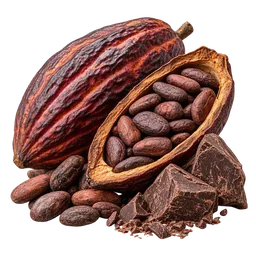
Cocoa / Cacao
Best for
Make arteries more flexible
Likely benefit 2–26 weeks 1 meta-analysis, n=1.2k #2 of 45 studied
- 45 papers
- 3 of 95 outcomes
- 3 positive
- 1 severe
Cocoa likely benefits artery flexibility, with stronger evidence for smoother blood-vessel function than for the smaller blood-pressure changes seen across broader outcomes.
Median effective dose, most-studied outcomes
- Lower your systolic pressure 10 g 2–26 wk
- Lower your diastolic pressure 30 g 2–26 wk
- Help your vessels widen with blood flow 664 mg 2–26 wk
Risk, worst reported severity
- ischemic stroke severe
- lower extremity revascularization moderate
What cocoa / cacao actually does
| Outcome | Effect | Evidence | Dose | Time | Rank |
|---|---|---|---|---|---|
| Clear benefits 1 | |||||
| Make arteries more flexible Likely benefit Flexible arteries help blood move smoothly and reduce strain on the heart. | | 1 meta-analysis 10 papers · n=1.2k | — | 2–26 wk | #2 /45 |
| Modest benefits 1 | |||||
| Lower blood pressure Proven modest benefit Blood pressure is the force of blood against artery walls, and high levels strain the heart. | | 3 meta-analyses 17 papers · n=4.1k | — | 2–26 wk | #5 /82 |
| Worth watching 1 | |||||
| Lower systemic inflammation Promising early signal The immune system can drive body-wide inflammation that affects long-term health and how people feel day to day. | | 5 RCTs 5 papers · n=128 | — | 2–12 wk | — |
Effect tiers come from native-unit MCID where available, Cohen's d otherwise.
Dose, timing & forms
How much
For vascular support, the better-studied approaches span food-scale cocoa servings and flavanol-standardized products. Blood pressure trials commonly use roughly 10 to 30 g/day of cocoa-containing powder or comparable products for about 2 to 4 weeks, although protocols range wider and the average reduction is small.24 Studies of blood-flow responsiveness also include concentrated flavanol preparations, so the cocoa weight alone does not tell you the active dose.13
When and how long
Use it daily, not as an occasional dessert. Trials generally assess regular intake across weeks, and the vascular signal comes from repeated exposure rather than a specific morning or evening window.12 If cocoa or chocolate makes you feel wired, take it earlier in the day, since cocoa naturally contains stimulating methylxanthines such as theobromine and small amounts of caffeine.3
Forms & standardisation
Look for a product that states its cocoa flavanol content, rather than relying on words such as "raw," "premium," or a high cacao percentage. Flavanol-rich cocoa and standardized extracts have the clearest trial connection to nitric oxide signaling and vessel widening.13 Dark chocolate can fit, but its flavanol dose varies substantially and it often adds sugar and calories that a powder or extract does not.2
Studied range, by outcome
| Outcome | Studied range | Median effective | Duration | Evidence |
|---|---|---|---|---|
| Lower your systolic pressure | 2–50 g | 10 g | 2–26 wk | 16 papers 6 sig. endpoints |
| Lower your diastolic pressure | 2–50 g | 30 g | 2–26 wk | 15 papers 1 sig. endpoint |
| Help your vessels widen with blood flow | — | 664 mg | 2–26 wk | 7 papers 9 sig. endpoints |
| Support overall antioxidant capacity | 900–1,300 mg | 900 mg | 4 wk | 2 papers 1 sig. endpoint |
| Support a steadier stress response | 40 g | 40 g | — | 1 paper 4 sig. endpoints |
Adverse events and drug interactions
Safety events
Recommended Cocoa / Cacao products
Real products that dose Cocoa / Cacao where the research does, in a clean formulation, from brands we've audited. We only list ones we'd stand behind.
-

Nootropics Depot
Chocamine Extract 2580 Grams
Well dosed 1,000 mg/day A formulaBrand audit 87/100
-

BulkSupplements.com
Cocoa Bean Extract
Well dosed 500 mg/day A formulaBrand audit 54/100
-

BulkSupplements.com
Cocoa Bean Extract Powder 500 mg
Well dosed 500 mg/day A formulaBrand audit 54/100
-

Bluebonnet
100% Natural Whey Protein Isolate Natural Chocolate
Well dosed 225 mg/day A formulaBrand audit 82/100
-

NOW
Tru Hoodia Complex
Well dosed 800 mg/day C formulaBrand audit 87/100
-

SuperSmart
Metadrine
Well dosed 600 mg/day A formulaBrand audit 63/100
Chosen for adequate Cocoa / Cacao dosing vs. the studied range, a clean formulation (grade A–C), and independent brand-quality audits. Not sponsored.
What this is and how it works
- Across 10 studies (n=1,159), cocoa improved artery flexibility across 68 measured endpoints.1
- The reviewed evidence spans 45 papers and 95 outcomes, including vascular function, blood pressure, and inflammation.
- Findings apply mainly to studied flavanol-rich cocoa products, not every chocolate bar.
Cocoa comes from the fermented, dried seeds of the cacao tree. Those seeds become cocoa powder, chocolate, or concentrated extracts, but processing can strip out a large share of their natural flavanols. The useful distinction is not raw versus roasted. It is whether the final product delivers a measured amount of cocoa flavanols.13
Cocoa flavanols prompt the vessel lining to release more nitric oxide, a signal that tells nearby vessel muscle to loosen. Think of nitric oxide as the green light at a series of narrow road gates: blood moves through with less resistance when the gates open on cue.1 Better vessel response explains the stronger evidence for artery flexibility and the smaller average shift in blood pressure.23
Bottom line
Cocoa makes the most sense for someone who wants a food-based nudge toward healthier vessel function and has realistic expectations about blood pressure. The artery-flexibility evidence is stronger than the blood pressure effect, which is real but small on average.12 Skip the idea that any chocolate bar works like a studied flavanol product, and check with a clinician first if you have significant health concerns or use medication that affects circulation or blood pressure.
Co-studied with

Common questions
Does cocoa actually lower blood pressure?
What is the difference between cocoa and cacao supplements?
How long does cocoa take to support blood vessels?
Is dark chocolate the same as a cocoa flavanol supplement?
Sources
Sources
- 1. Flavanol-rich cocoa induces nitric oxide-dependent vasodilation in healthy humans (2003) ↑
- 2. Cocoa consumption and blood pressure (2017) ↑
- 3. Cocoa reduces blood pressure and insulin resistance and improves endothelium-dependent vasodilation in hypertensives (2005) ↑
- 4. Effects of cocoa consumption on blood pressure in adults: a systematic review and meta-analysis of randomized controlled trials
- 5. The effect of cocoa consumption on markers of inflammation: a systematic review and meta-analysis of randomized controlled trials
Generated August 27, 2026
Related
More evidence for Cocoa / Cacao
Evidence map
Focus & memory
NewFocus & memory: evidence map across 45 supplements
Evidence coverage map
Jul 30, 2026
Ingredient evidence
Ingredient evidence
NewBeet nitrate
All scored outcomes
Aug 27, 2026
Ingredient evidence
Ingredient evidence
NewBlack Garlic
All scored outcomes
Aug 27, 2026
Ingredient evidence
Ingredient evidence
NewChokeberry
All scored outcomes
Aug 27, 2026
Ingredient evidence
Ingredient evidence
NewFlavan-3-ols
All scored outcomes
Aug 27, 2026
Ingredient evidence
Ingredient evidence
NewGarlic
All scored outcomes
Aug 27, 2026