New Ashwagandha (Withania somnifera) Published Mar 10, 2026
Smell of a Horse, Calm in a Storm: Ashwagandha's ancient promise meets modern stress
Deeper sleep, steadier stress response, and sustained energy without stimulation
Evidence summary
Ashwagandha reduces perceived stress and anxiety in adults and modestly improves sleep, with benefits most consistent after at least eight weeks of use.
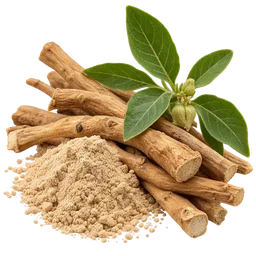
The first surprise is in the name. Ashwagandha literally means "smell of a horse," a nod to roots said to carry the animal's odor—and, in Ayurveda, its vigor. Yet this earthy plant is most famous today for something quieter: helping people sleep, steady their nerves, and endure daily stress. How did a herb named for horsepower become shorthand for calm? 1
From Sanskrit to subway
For more than two millennia, ashwagandha has lived in India's medical canon as a Rasayana—a class of rejuvenators meant to restore strength, resilience, and longevity. Classical texts place it alongside other tonics designed to steady a person through life's seasons, not just treat a single symptom. Think of Rasayana as an old operating system for human robustness, with ashwagandha as one of its core apps. 23 Modern guides echo the heritage while translating it for today's concerns: stress, sleep, fertility, and athletic performance. The U.S. National Institutes of Health summarizes the state of play plainly: some preparations may help with insomnia and stress, with mixed evidence for anxiety; long-term safety isn't well known. 12
What the trials actually show
When researchers put ashwagandha under the bright lights of randomized trials, a pattern emerges: modest but meaningful relief over weeks. A 2024 meta-analysis of randomized controlled trials found significant improvements on standard stress and anxiety scales and reductions in cortisol—the body's "go" hormone that spikes under pressure. 3 Picture cortisol as the office fire alarm; ashwagandha seems to help reset the sensitivity so it doesn't blare at every burnt piece of toast. Another 2024 review focusing on anxiety and insomnia concluded that ashwagandha extracts improved several sleep measures—time to fall asleep, sleep efficiency, total sleep time—though studies were small and varied. 5 If you've ever watched a child's mobile gently slow, that's the feel of these data: motion settling, not forced stillness. Zoom in on individual trials and the story gains texture. In one double-blind, placebo-controlled study, adults with chronic stress took 300 mg of a standardized root extract twice daily. After 60 days, they reported lower perceived stress and showed lower cortisol than placebo. 6 Another trial in people with non-restorative sleep used a 120 mg extract daily and saw better sleep efficiency and shorter time to nod off over six weeks. 7 These aren't knockout sedatives; they read more like the body learning to coast again. Not every analysis is glowing. A 2022 dose-response meta-analysis reported benefits for stress and anxiety but graded the overall certainty as low, urging better, larger trials. 4 That humility matters: the herb's promise is real, but the measuring sticks need to be sturdier.
A quiet caution: the rare plot twists
Most people in studies tolerate ashwagandha for a few months with only mild complaints like drowsiness or stomach upset. But rare events remind us that "natural" is not a synonym for "risk-free." Regulators in Australia advised consumers in 2024 that products containing Withania somnifera may, in rare cases, injure the liver; those with current or past liver problems should avoid it. 8
"If you currently have or have had liver problems, you should avoid..Withania somnifera," their notice states. 8 Case reports from several countries describe cholestatic or mixed-pattern liver injuries appearing weeks after people began supplements, with most resolving after stopping; a few required intensive care. 111213 Separately, clinicians have documented rare episodes of thyrotoxicosis—an overactive thyroid—linked to use, which reversed after discontinuation. 910 These are outliers, but they shape wise use: if your liver or thyroid has a backstory, involve your clinician before starting.
The hidden variable: what's in the bottle?
In Ayurveda, the root is the star. In the modern marketplace, you'll find root-only, root-and-leaf blends, and sometimes unlabeled mixes. Why care? Leaves naturally have different withanolides—the plant's signature compounds—than roots, and undisclosed blending can skew potency and effects. In 2019, a quality-watchdog consortium warned about economic adulteration with undeclared leaf material. As American Botanical Council founder Mark Blumenthal put it, "The inappropriate and unethical practice of increasing the amount of withanolides..by adding undisclosed, lower-cost dry leaf material..has been confirmed." 1415 Choose brands that disclose plant parts, standardization, and third-party testing.
How it likely works (in human terms)
Rather than "modulating pathways," think of ashwagandha as coaching two interlocking systems back into rhythm: the stress-response network that runs from brain to adrenal glands, and the sleep-wake circuitry that rewards consistent cues. Trials repeatedly show changes in feelings (lower perceived stress), hormones (often lower cortisol), and sleep architecture (more time asleep, less time staring at the ceiling). It's less a hammer and more a metronome. 3567
Putting it to work (without the hype)
For stress and sleep, many trials cluster around 300–600 mg/day of standardized root extract for 6–8 weeks, often with food and evening dosing if sleep is the target. 167
Expect gradual benefits. Some feel calmer within a couple of weeks; most measurable changes show up by week 6–8. 567
If you lift or run, small trials suggest potential gains in VO₂max, recovery, and strength over 8–12 weeks when paired with training—but this is a secondary lane, not the main road. 1617
Quality matters: look for root-only products unless a root-and-leaf blend is clearly labeled; insist on third-party testing (USP, NSF, Informed Choice). 1415
Stop and seek care if you notice dark urine, yellowing eyes/skin, severe itching, or unusual fatigue. 8
"It's challenging to develop recommendations for using ashwagandha, because studies have used various preparations and doses." 1 That line from the NIH captures the present moment: encouraging signals, uneven methods. Let it guide your expectations—and your shopping.
What we still don't know
Three gaps loom: (1) long-term safety beyond a few months; (2) head-to-head comparisons between root-only and root-plus-leaf extracts; (3) clarity on who benefits most—stressed but otherwise healthy adults, people with insomnia, or specific subgroups. Until then, ashwagandha is best treated as a supportive instrument in the orchestra: helpful for harmony, not a soloist meant to drown out medical care. 124
A closing thought
Ancient physicians designed Rasayana to help humans stay steady in an unsteady world. Today's studies hint that ashwagandha can still do that—dialing down the internal alarm and smoothing the edges of sleepless nights—provided we respect both its power and its limits. The root may smell like a horse, but the best outcomes arrive like a well-trained one: strong, steady, and responsive to the reins. 256
Key takeaways
What to walk away with
- 01
Rooted in Ayurveda as a Rasayana, ashwagandha is framed here as a resilience aid for sleep, stress, and steady energy—best used alongside lifestyle basics.
- 02
Evidence is promising: randomized trials report reduced perceived stress and cortisol and better sleep efficiency, total sleep time, and latency, with larger effects at higher doses and ≥8 weeks.
- 03
Practical dosing from trials commonly ranges 300–600 mg/day of standardized root extract; start low, reassess at 6–8 weeks, and avoid open-ended use without clinician input.
- 04
Timing matters: take in the evening with food for sleep support; split morning/evening for daytime calm—expect gradual changes, not a same-day knockout.
- 05
Cautions: stop and seek care for signs like dark urine, yellowing eyes/skin, severe itching, abdominal pain, or unusual fatigue; discuss use if on thyroid, sedative, immunosuppressant, or diabetes meds.
- 06
Philosophy: it's not a silver bullet—ashwagandha works best as part of a broader stress toolkit (sleep, movement, mindfulness).
Effect timeline
When to expect what
- Immediate
- No
- Peak
- 6–8 weeks
- Duration needed
- 8–12 weeks typical in trials
- Wears off
- Unknown; likely gradual over weeks after stopping
Research trajectory
What the studies actually show
-
Across nine randomized trials, ashwagandha reduced perceived stress and anxiety scores and lowered cortisol versus placebo. 3
2024 systematic review/meta-analysis pooled studies from 2000–2022.
Supports stress-relief claims with objective and subjective measures.
-
Pooled RCTs show improvements in sleep efficiency, total sleep time, and sleep latency; effects larger at higher doses and ≥8 weeks. 5
2024 anxiety/insomnia meta-analysis; small, heterogeneous studies.
Explains why consistent nightly use over weeks works better than sporadic dosing.
-
A 60-day RCT using 300 mg root extract twice daily decreased perceived stress and serum cortisol vs. placebo. 6
Adults with chronic stress were randomized, double-blind; safety acceptable over two months.
Anchors practical dosing and timeline used in many products.
Human trials
What real trials found
-
Adult developed jaundice two weeks after starting ashwagandha; recovered within five months after stopping. 11
- Outcome
- Self-limited cholestatic liver injury resolved with cessation.
- Why it matters
- Illustrates rare but notable liver risk.
- Source
- Clinical Case Reports (2023)
-
Case series of eight patients with liver injury from pure ashwagandha formulations. 12
- Outcome
- Most improved after discontinuation; some had underlying liver disease.
- Why it matters
- Highlights susceptibility in those with liver history.
- Source
- Hepatology Communications (2023)
-
Thyrotoxicosis after ashwagandha use; symptoms and labs normalized after stopping. 9
- Outcome
- Reversible hyperthyroidism linked to supplement use.
- Why it matters
- Signals thyroid-related caution.
- Source
- Case reports (2005; 2022)
Expert insights
Voices in the field
It's challenging to develop recommendations for using ashwagandha, because studies have used various preparations and doses. 1
The inappropriate and unethical practice of increasing the amount of withanolides...by adding undisclosed, lower-cost dry leaf material...has been confirmed. 14
Practical guidance
Putting it to use
Who may benefit
Stressed adults aiming to sleep better and feel steadier; people building a broader stress toolkit (sleep, exercise, mindfulness); recreational athletes pairing training with recovery support.
Who should avoid
Current or past liver disease; known thyroid disorders (hypo/hyper); men with hormone-sensitive prostate cancer; upcoming surgery.
Dosing
Standardized root extracts used in trials often range 300–600 mg/day; start low, reassess at 6–8 weeks, and avoid indefinite use without clinician input.
Timing
For sleep, evening dosing with food fits the data; for daytime calm, split morning/evening. Expect gradual change—not a same-day knockout.
Quality
Prefer root-only extracts unless a root-and-leaf blend is clearly labeled; choose third-party tested brands and avoid proprietary blends that obscure plant parts or withanolide levels.
Cautions
Stop and seek care for dark urine, yellowing eyes/skin, severe itching, abdominal pain, or unusual fatigue. Discuss use if you take thyroid, sedative, immunosuppressant, or diabetes medications.
A closing thought
Rasayana was never about a silver bullet; it was about cultivating resilience. In that spirit, ashwagandha works best when it's not the hero but part of an ensemble—sleep discipline, movement, and meaning—quietly helping the body remember how to exhale.
Frequently asked
Common questions
What dose should I start with, and how long until I notice effects?
When should I take ashwagandha for sleep versus daytime stress?
Who should avoid or be cautious with ashwagandha?
What side effects or warning signs mean I should stop?
How strong is the evidence for stress and sleep?
Is ashwagandha a standalone fix for burnout?
Related
More on this supplement
Pulled from across the site — rankings, comparisons, combinations, and reviews where this supplement shows up.
Ingredient evidence
Ingredient evidence
NewAshwagandha
All scored outcomes
Aug 27, 2026
Ranking
Deep, Restful Sleep
NewBest Supplements for Deep, Restful Sleep (2026)
Evidence ranking
Mar 29, 2026
Ranking
Low Testosterone
NewBest Supplements for Testosterone, Ranked by Evidence
Evidence ranking
Apr 4, 2026
Ranking
Trouble Falling Asleep
NewBest Supplements to Fall Asleep Faster, Ranked by Clinical Evidence
Evidence ranking
May 27, 2026
Ranking
Daily Stress
NewBest Supplements for Daily Stress Relief, Ranked by Clinical Evidence
Evidence ranking
Apr 4, 2026
Ranking
Hair Growth
NewBest Supplements to Speed Up Hair Growth (2026)
Evidence ranking
May 16, 2026
Sources
- 1. Ashwagandha: Health Professional Fact Sheet (updated May 2, 2025) (2025)
- 2. Ashwagandha: Usefulness and Safety | NCCIH (2025)
- 3. Effects of Ashwagandha on stress and anxiety: systematic review and meta-analysis (2024) (2024)
- 4. Does ashwagandha help anxiety and stress? Systematic review and dose-response meta-analysis (2022) (2022)
- 5. Safety and efficacy of Withania somnifera for anxiety and insomnia: Systematic review and meta-analysis (2024) (2024)
- 6. Chandrasekhar et al., 2012 RCT on stress, 600 mg/day root extract (2012)
- 7. Randomized, placebo-controlled trial of 120 mg ashwagandha extract for non-restorative sleep (2020) (2020)
- 8. TGA safety advisory on Withania somnifera (Feb 22, 2024) (2024)
- 9. Thyrotoxicosis following the use of ashwagandha (2005) (2005)
- 10. Ashwagandha as a unique cause of thyrotoxicosis with SVT (2022) (2022)
- 11. Ashwagandha-induced acute liver injury: case report (2023) (2023)
- 12. Ashwagandha-induced liver injury: case series (2023) (2023)
- 13. From Herb to Harm: A Rare Encounter of Ashwagandha-Induced Liver Injury (ACG abstract, 2023) (2023)
- 14. BAPP bulletin coverage and Blumenthal quote on adulteration (2019) (2019)
- 15. ABC-AHP-NCNPR BAPP press release on ashwagandha root adulteration (2019) (2019)
- 16. Ashwagandha improves VO₂max and recovery in athletic adults (2021 RCT) (2021)
- 17. Standardized root extract with resistance training improves strength and endurance (2024 RCT) (2024)
- 18. 30-day RCT on cognition/mood with ashwagandha (2021) (2021)
1,090 words · 18 sources · Ashwagandha (Withania somnifera)