KSM-66
Best for
Stay asleep through the night
Likely strong benefit 120–600 mg/day 10 weeks 1 meta-analysis, n=339 #1 of 15 studied
- 36 papers
- 17 of 112 outcomes
- 16 positive
- 3 severe
KSM-66 delivers likely strong benefits for sleep, especially faster sleep onset and longer uninterrupted sleep, while evidence across other outcomes remains less consistent.
Risk, worst reported severity
- hepatotoxicity (drug-induced liver injury) severe
- adrenal hypofunction (adrenal insufficiency) severe
What ksm-66 actually does
Testosterone levels in men are tied to sex drive, erections, muscle mass, and energy. 19501822 · 24371462 · 26609282 +4
Sleep quality reflects whether the night leaves you feeling well rested. 31728244 · 32021735 · 32226684 +4
Sexual desire and arousal can make intimacy feel more wanted and engaging. 35873404 · 36447681 · 40582043 +1
Recovery helps your body feel ready for the next training session after hard exercise. 33670194 · 38931168 · 39954269 +2
Everyday energy helps you get through daily tasks without feeling worn down. 33600918 · 35873404 · 41656269
More muscle can support strength, movement, and the physical changes you train for. 26609282 · 38988644 · 41156498
Feeling alert in the morning can make the day easier to start. 31728244 · 32226684 · 34559859
Fight-or-flight is the surge that readies your body when it senses pressure or danger. 40875185 · 41599843
Anxiety during menopause can bring worry, tension, and difficulty feeling at ease. 41561822
| Outcome | Effect | Evidence | Dose | Time | Rank |
|---|---|---|---|---|---|
| Strong benefits 2 | |||||
| Stay asleep through the night Likely strong benefit Uninterrupted sleep helps the night feel more settled and restorative. | | 1 meta-analysis 2 papers · n=339 | 120–600 mg | 10 wk | #1 /15 |
| Fall asleep sooner Likely strong benefit A shorter wait for sleep can make bedtime feel less frustrating. | | 1 meta-analysis 2 papers · n=339 | 120–600 mg | 10 wk | #3 /20 |
| Clear benefits 1 | |||||
| Feel less stressed day to day Likely benefit Daily stress is the sense that life's demands are stretching beyond what you can handle. | | 1 meta-analysis 9 papers · n=965 | — | 4–12 wk | #2 /28 |
| Modest benefits 4 | |||||
| Raise testosterone levels in men Proven modest benefit Testosterone levels in men are tied to sex drive, erections, muscle mass, and energy. | | 1 meta-analysis 7 papers · n=695 | — | 8–12 wk | #2 /12 |
| Sleep that feels more restorative Proven modest benefit Sleep quality reflects whether the night leaves you feeling well rested. | | 1 meta-analysis 7 papers · n=507 | 120–700 mg | 4–12 wk | #3 /34 |
| Get more sleep each night Likely modest benefit More time asleep can help you meet the amount of sleep you need. | | 1 meta-analysis 2 papers · n=339 | 120–600 mg | 10 wk | #4 /9 |
| Feel less anxious Proven but unnoticeable Anxiety can bring persistent worry, unease, and physical tension into ordinary moments. | | 1 meta-analysis 7 papers · n=411 | 125–600 mg | 8–12 wk | #2 /30 |
| Worth watching 6 | |||||
| Feel more sexual desire Large effect, needs confirmation Sexual desire and arousal can make intimacy feel more wanted and engaging. | | 3 RCTs 4 papers · n=291 | 300–600 mg | 8 wk | #5 /9 |
| Recover better after exercise Large effect, needs confirmation Recovery helps your body feel ready for the next training session after hard exercise. | | 1 meta-analysis 5 papers · n=130 | 120–1000 mg | 4–8 wk | — |
| Feel less tired every day Promising early signal Everyday energy helps you get through daily tasks without feeling worn down. | | 3 RCTs 3 papers · n=213 | 300–700 mg | 8–9 wk | #4 /31 |
| Build more muscle Promising early signal More muscle can support strength, movement, and the physical changes you train for. | | 3 RCTs 3 papers · n=161 | 600 mg | 8 wk | — |
| Get stronger Promising early signal Strength helps your muscles produce more force for lifting, carrying, and daily movement. | | 1 meta-analysis 4 papers · n=153 | 240–600 mg | 4–8 wk | #4 /41 |
| Support male fertility hormones Promising early signal Male reproductive hormones help regulate sperm production and sexual development. | | 1 RCT 3 papers · n=146 | 600–5000 mg | 8–12 wk | #1 /3 |
| Early research 4 | |||||
| Wake up more refreshed Faint early signal Feeling alert in the morning can make the day easier to start. | | 1 meta-analysis 3 papers · n=267 | 600 mg | 10–12 wk | #4 /16 |
| Calm the fight-or-flight response Faint early signal Fight-or-flight is the surge that readies your body when it senses pressure or danger. | | 2 RCTs 2 papers · n=28 | 125–600 mg | 6–12 wk | #4 /9 |
| Ease anxiety during menopause Not enough research Anxiety during menopause can bring worry, tension, and difficulty feeling at ease. | | 1 study 1 papers · n=— | 300 mg | 8 wk | — |
| Lift your overall mood Not enough research Mood shapes how positive, calm, and engaged a person feels from day to day. | | 2 RCTs 2 papers · n=— | 125–600 mg | 9–12 wk | — |
Effect tiers come from native-unit MCID where available, Cohen's d otherwise.
Dose, timing & forms
How much
For the best-supported goals, trials commonly used 600 mg per day of KSM-66 root extract, often as 300 mg twice daily, for roughly 8 to 10 weeks. That protocol improved stress measures in adults over 60 days and improved sleep measures over 10 weeks.12 Exercise studies also used daily KSM-66 alongside resistance training, but those results remain promising rather than settled.3
When and how long
Consistency matters more than chasing an immediate effect. Sleep research used a morning and evening routine, while stress protocols also split the daily amount into two doses.12 If your goal is sleep, make the evening dose part of your regular wind-down routine. If it upsets your stomach, taking it with a meal is a sensible practical adjustment.
Forms & standardisation
Choose a product that explicitly identifies KSM-66 and lists it as a root extract, not a generic ashwagandha blend. Look for disclosed withanolide standardization, since that is the concentrated compound family in the tested extract.12 Do not assume that a raw powder, leaf-containing extract, or a product with an undisclosed extract profile will produce the same results.
Adverse events and drug interactions
Safety events
Recommended KSM-66 products
Real products that dose KSM-66 where the research does, in a clean formulation, from brands we've audited. We only list ones we'd stand behind.
-

NutraBio
KSM-66 Ashwagandha
Well dosed 600 mg/day A formulaBrand audit 90/100
-

Nootropics Depot
KSM-66 Powder
Well dosed 600 mg/day A formulaBrand audit 87/100
-

Nootropics Depot
KSM-66 Powder 5 grams
Well dosed 300 mg/day A formulaBrand audit 87/100
-

Seeking Health
Ashwagandha Extract 467 mg
Well dosed 467 mg/day A formulaBrand audit 85/100
-

NOW
KSM-66 Ashwagandha
Well dosed 600 mg/day B formulaBrand audit 87/100
-

Swanson
Ultimate Ashwagandha 250 mg KSM-66
Well dosed 500 mg/day A formulaBrand audit 69/100
Chosen for adequate KSM-66 dosing vs. the studied range, a clean formulation (grade A–C), and independent brand-quality audits. Not sponsored.
What this is and how it works
- Across 2 studies (n=339), KSM-66 improved sleep onset and sleep duration in healthy adults.1
- The review covers 36 papers and 112 outcomes, with strongest evidence concentrated on sleep and stress-related measures.
- Testosterone, sexual desire, exercise recovery, and muscle gains have less certain support than sleep outcomes.3
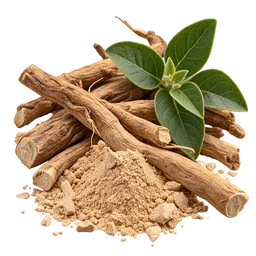
KSM-66 is a branded extract made from the root of ashwagandha, a shrub long used in traditional Indian wellness practices. It is not the same thing as plain root powder. The extract concentrates naturally occurring compounds called withanolides while using the root rather than the leaf.1
Stress uses a hormonal alarm circuit that tells your body when to stay on high alert. KSM-66 appears to turn down that alarm circuit, including cortisol output, like lowering the volume on a smoke alarm after the toast stops burning.2 That shift offers a plausible link to its stress and sleep findings, although the clinical trials measure the outcomes more directly than the mechanism itself.12
Bottom line
KSM-66 is a reasonable option if your main goal is better sleep continuity or a steadier response to everyday stress, and you are willing to use it consistently for several weeks.12 Treat testosterone, sexual desire, workout recovery, and muscle gains as secondary possibilities with less certain evidence.3 Skip self-experimenting and get clinical guidance first if you have liver, thyroid, or adrenal concerns, or if you take medication.
Common questions
Does KSM-66 help you sleep?
How long does KSM-66 take to work for stress?
Is KSM-66 useful for muscle gains?
Is KSM-66 the same as regular ashwagandha?
Sources
Sources
- 1. Efficacy and Safety of Ashwagandha Root Extract on Sleep Quality in Healthy Adults (2019) ↑
- 2. A Prospective, Randomized Double Blind, Placebo Controlled Study of Safety and Efficacy of a High Concentration Full Spectrum Extract of Ashwagandha Root in Reducing Stress and Anxiety in Adults (2012) ↑
- 3. Examining the Effect of Withania somnifera Supplementation on Muscle Strength and Recovery: A Randomized Controlled Trial (2015) ↑
- 4. Safety and efficacy of ashwagandha root extract in improving memory and cognitive functions (2019) ↑
Generated August 27, 2026
Related
More evidence for KSM-66
Evidence map
Focus & memory
NewFocus & memory: evidence map across 45 supplements
Evidence coverage map
Jul 30, 2026
Evidence map
Sleep
NewSleep: evidence map across 37 supplements
Evidence coverage map
Jul 30, 2026
Evidence map
Stress
NewStress: evidence map across 46 supplements
Evidence coverage map
Jul 30, 2026