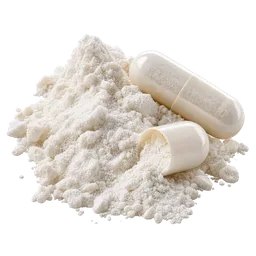
Glucosamine
Best for
Feel less pain
Large effect, needs confirmation 500–1500 mg/day 8–130 weeks 8 meta-analyses, n=56.6k #2 of 50 studied
- 29 papers
- 4 of 33 outcomes
- 3 positive
- 3 severe, 7 major interactions
Glucosamine provides a proven benefit for easier movement and less pain in people with osteoarthritis, while effects across other joint outcomes are less consistent and cartilage changes remain too subtle to feel.
Median effective dose, most-studied outcomes
- Move more easily with joint problems 1,500 mg 12–104 wk
- Move with less joint pain 1,500 mg 12–104 wk
- Feel less intense pain 1,500 mg 8–130 wk
Risk, worst reported severity
- myocardial infarction severe
- cerebrovascular accident (stroke) severe
- warfarin major
- acetaminophen major
What glucosamine actually does
| Outcome | Effect | Evidence | Dose | Time | Rank |
|---|---|---|---|---|---|
| Clear benefits 1 | |||||
| Ease joint pain Proven benefit Comfortable joints can make walking, stairs, and everyday movement easier. | | 9 meta-analyses 16 papers · n=49k | 500–2000 mg | 9–104 wk | #2 /23 |
| Modest benefits 2 | |||||
| Move with less stiffness Proven modest benefit Stiff joints can make everyday movements feel restricted or uncomfortable. | | 2 meta-analyses 6 papers · n=7.3k | 500–1501 mg | 12–24 wk | #1 /10 |
| Slow knee osteoarthritis progression Proven but unnoticeable Knee osteoarthritis can gradually damage cartilage and make daily movement more difficult. | | 4 meta-analyses 7 papers · n=44k | 1500 mg | 24–156 wk | #1 /9 |
| Worth watching 1 | |||||
| Feel less pain Large effect, needs confirmation Pain relief can make it easier to move, rest, focus, and get through the day. | | 8 meta-analyses 13 papers · n=57k | 500–1500 mg | 8–130 wk | #2 /50 |
Effect tiers come from native-unit MCID where available, Cohen's d otherwise.
Dose, timing & forms
How much
For joint pain and day-to-day function, the most common effective target across trials is 1,500 mg daily of oral glucosamine. Studies tested 500 to 2,000 mg per day, but 1,500 mg is the recurring protocol for pain, stiffness, and mobility outcomes.12 Expect a modest improvement in stiffness and a more meaningful, though not dramatic, improvement in joint pain for people who respond.23
When and how long
Use glucosamine every day and assess it after roughly 12 weeks, because that is the typical trial length for pain and stiffness rather than a window for immediate relief.12 Longer studies followed participants for months to years when looking at joint structure, but any structural change was small and not a reason to expect a noticeable cartilage makeover.13 Pick a time you can repeat consistently. The research does not establish a single best time of day.2
Forms & standardisation
Do not treat every glucosamine product as interchangeable. The landmark long-term knee trial used glucosamine sulfate, whereas broader reviews that pooled different preparations found conflicting results.13 Look for a label that clearly names glucosamine sulfate or glucosamine hydrochloride and gives the actual daily glucosamine amount, not only the weight of a multi-ingredient joint blend.
Studied range, by outcome
| Outcome | Studied range | Median effective | Duration | Evidence |
|---|---|---|---|---|
| Move more easily with joint problems | 500–2,000 mg | 1,500 mg | 12–104 wk | 14 papers 5 sig. endpoints |
| Move with less joint pain | 500–2,000 mg | 1,500 mg | 12–104 wk | 13 papers 12 sig. endpoints |
| Feel less intense pain | 500–1,500 mg | 1,500 mg | 8–130 wk | 12 papers 5 sig. endpoints |
| Preserve knee joint structure | 1,500 mg | — | 24–156 wk | 7 papers |
| Move more freely after rest | 500–1,501 mg | 1,500 mg | 12–24 wk | 6 papers 6 sig. endpoints |
| Ease the daily burden of arthritis | 500–2,000 mg | 1,500 mg | 12–24 wk | 5 papers 5 sig. endpoints |
| Reach meaningful arthritis relief | 1,500 mg | — | 104 wk | 1 paper |
| Slow cartilage breakdown | 1,500 mg | — | 24 wk | 1 paper |
Adverse events and drug interactions
Safety events
Drug interactions
Recommended Glucosamine products
Real products that dose Glucosamine where the research does, in a clean formulation, from brands we've audited. We only list ones we'd stand behind.
-

Pure Encapsulations
Glucosamine HCl
Well dosed 2,600 mg/day A formulaBrand audit 78/100
-

Nature's Answer
Glucosamine + Chondroitin 1350 mg
Well dosed 1,500 mg/day B formulaBrand audit 75/100
-

Nature's Answer
Glucosamine And Chondroitin 1,350 mg
Well dosed 1,500 mg/day B formulaBrand audit 75/100
-

Source Naturals
Glucosamine Chondroitin Complex With MSM
Well dosed 1.5 Gram(s)/day B formulaBrand audit 73/100
-

Karuna
GlucoSulfate KCl
Well dosed 1,500 mg/day A formula -

Paradise
V-Glucosamine Plant Based
Well dosed 1,500 mg/day A formula
Chosen for adequate Glucosamine dosing vs. the studied range, a clean formulation (grade A–C), and independent brand-quality audits. Not sponsored.
What this is and how it works
- Across 16 studies (n=49,120), movement and pain outcomes were mixed across 80 endpoints.2
- Twenty-nine reviewed papers span 33 outcomes, including pain, stiffness, movement, and osteoarthritis progression.
- Evidence is strongest for symptom relief after roughly three months, not noticeable cartilage preservation.
Cartilage cells use glucosamine as a raw ingredient for the gel-like mesh that helps a joint handle pressure. In lab studies, glucosamine also quieted an inflammatory signaling switch inside cartilage cells, much like turning down a smoke alarm that keeps ringing after the kitchen has cleared.5 Human trials test symptoms and joint changes, but they do not establish that this cell-level action explains every result people feel.13
Bottom line
Glucosamine is worth a time-limited trial if joint pain or stiffness makes ordinary movement harder and you are comfortable waiting about three months to judge it. Keep expectations grounded: pain relief has the best support, stiffness relief is smaller, and evidence for preserving cartilage changes is too subtle to feel.123 Skip self-starting it if you take medicines with important interaction risks, and ask a clinician or pharmacist first.
Co-studied with
 Chondroitin36 shared
· d=0.31
Chondroitin36 shared
· d=0.31 Vitamind36 shared
· d=0.25
Vitamind36 shared
· d=0.25 Methylsulfonylmethane30 shared
· d=0.16
Methylsulfonylmethane30 shared
· d=0.16 Guava30 shared
· d=0.16
Guava30 shared
· d=0.16 Vitaminb130 shared
· d=0.16
Vitaminb130 shared
· d=0.16 Chondroitinsulfate6 shared
· d=0.69
Chondroitinsulfate6 shared
· d=0.69 Collagen6 shared
· d=0.69
Collagen6 shared
· d=0.69 Quercetin6 shared
· d=0.69
Quercetin6 shared
· d=0.69 Carnosine6 shared
· d=0.69
Carnosine6 shared
· d=0.69 Turmeric5 shared
· d=1.18
Turmeric5 shared
· d=1.18 Hyaluronicacid3 shared
Common questions
How long does glucosamine take to work for joint pain?
Does glucosamine rebuild cartilage?
Is glucosamine sulfate better than glucosamine hydrochloride?
Can glucosamine be taken every day?
Sources
Sources
- 1. Long-term effects of glucosamine sulphate on osteoarthritis progression: a randomised, placebo-controlled clinical trial (2001) ↑
- 2. Glucosamine therapy for treating osteoarthritis (2005) ↑
- 3. Effects of glucosamine, chondroitin, or placebo in patients with osteoarthritis of hip or knee: network meta-analysis (2010) ↑
- 4. Glucosamine, chondroitin sulfate, and the two in combination for painful knee osteoarthritis (2006) ↑
- 5. Glucosamine inhibits IL-1beta-induced NFkappaB activation in human osteoarthritic chondrocytes (2003) ↑
Generated August 27, 2026
Related
More evidence for Glucosamine
Evidence guide
Glucosamine
NewTwo Lives of a Sugar: How Glucosamine Became a Joint Icon—and a Scientific Puzzle
Evidence guide
Apr 29, 2026
Ranking
Arthritis and joint pain
NewBest Supplements for Arthritis and Joint Pain, Ranked by Clinical Evidence
Evidence ranking
Apr 4, 2026
Systematic review
Systematic review
NewGlucosamine for Joint Health: A Systematic Evidence Review
GRADE evidence review
Jun 19, 2026
Ingredient evidence
Ingredient evidence
NewBoswellia
All scored outcomes
Aug 27, 2026
Ingredient evidence
Ingredient evidence
NewCannabidiol
All scored outcomes
Aug 27, 2026
Ingredient evidence
Ingredient evidence
NewChondroitin
All scored outcomes
Aug 27, 2026