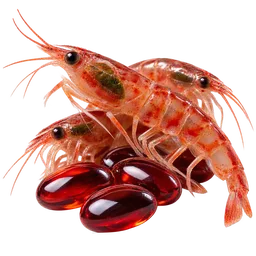
Krill Oil
Best for
Lower triglycerides
Likely modest benefit 1300–4000 mg/day 4–26 weeks 3 studies, n=606 #1 of 80 studied
- 6 papers
- 1 of 17 outcomes
- 1 positive
Krill oil provides a likely modest benefit for post-meal triglycerides, while evidence for broader health outcomes remains narrow and does not support sweeping claims.
What krill oil actually does
| Outcome | Effect | Evidence | Dose | Time | Rank |
|---|---|---|---|---|---|
| Modest benefits 1 | |||||
| Lower triglycerides Likely modest benefit High triglycerides are blood fats linked with a higher risk of heart disease. | | 4 RCTs 3 papers · n=606 | 1300–4000 mg | 4–26 wk | #1 /80 |
Effect tiers come from native-unit MCID where available, Cohen's d otherwise.
Dose, timing & forms
How much
For the best-supported use, post-meal triglycerides, reviewed studies used roughly 1,300 to 4,000 mg daily of krill oil for weeks to months.1 The response is modest, so more is not automatically better. Use the product's labeled daily serving and judge results with a lipid test if triglycerides are your goal.1
When and how long
No reviewed trial establishes that morning or evening use works better. What matters is taking krill oil daily over the full study period, rather than treating it like an occasional after-meal supplement.1 Taking it with a meal is a practical choice for people who notice stomach discomfort, and it fits its role as a dietary fat supplement.
Forms & standardisation
Choose actual krill oil rather than a generic "omega-3 complex," and check the label for the amount of EPA and DHA per serving, not only the total oil weight. Krill oil's distinctive feature is its phospholipid-bound omega-3 content, so a label that identifies phospholipids and EPA plus DHA gives you more useful information than a large front-label oil number.2
Adverse events and drug interactions
Safety events
Recommended Krill Oil products
Real products that dose Krill Oil where the research does, in a clean formulation, from brands we've audited. We only list ones we'd stand behind.
-

Life Extension
Krill Healthy Joint Formula
Well dosed 353 mg/day A formulaBrand audit 90/100
-

Swanson
Krill Oil & Astaxanthin
Well dosed 500 mg/day A formulaBrand audit 69/100
-

Swanson
100% Pure Krill Oil
Well dosed 1,000 mg/day A formulaBrand audit 69/100
-

Puritan's Pride
Krill Oil 500 mg
Well dosed 500 mg/day A formulaBrand audit 68/100
-

21st Century
Krill Oil 350 mg
Well dosed 350 mg/day A formulaBrand audit 77/100
-

NOW
Krill 1000 Double Strength
Well dosed 3 Gram(s)/day A formulaBrand audit 87/100
Chosen for adequate Krill Oil dosing vs. the studied range, a clean formulation (grade A–C), and independent brand-quality audits. Not sponsored.
What this is and how it works
- Across 3 studies (n=606), krill oil lowered post-meal triglycerides; the available summary does not report an effect size or MCID comparison.1
- Six papers reviewed here covered 17 outcomes, with strongest evidence concentrated in post-meal triglycerides.
- Evidence includes hyperlipidemic and healthy adults, leaving broader benefits uncertain.
Krill oil comes from tiny shrimp-like crustaceans that live in cold ocean waters. It supplies the omega-3 fats EPA and DHA, plus naturally occurring phospholipids and a red-orange antioxidant pigment called astaxanthin.2
Bottom line
Krill oil makes the most sense if you want a convenient omega-3 supplement and are aiming for a small improvement in triglycerides after meals.1 Skip the hype around broad benefits: the reviewed evidence is narrow, and the triglyceride effect is small. It is also a poor fit if it causes stomach discomfort, headaches, or unwanted sedation.
Common questions
Does krill oil lower triglycerides?
Is krill oil better than fish oil?
How long does krill oil take to work?
Sources
Sources
Generated August 27, 2026
Related