Protein
Best for
Build more muscle
Proven benefit 10–80 g/day 1 meta-analysis, n=5.3k #2 of 37 studied
- 8 papers
- 3 of 15 outcomes
- 2 positive
Protein supplementation provides a proven benefit for muscle growth and lifting strength, especially alongside resistance training, while offering a modest edge rather than transformation.
Risk, worst reported severity
- Subject felt unwell after exercise and dropped out
What protein actually does
Body fat loss changes the proportion of your body that is fat tissue. 40717998
| Outcome | Effect | Evidence | Dose | Time | Rank |
|---|---|---|---|---|---|
| Clear benefits 2 | |||||
| Get stronger Proven benefit Strength helps your muscles produce more force for lifting, carrying, and daily movement. | | 2 meta-analyses 3 papers · n=5.7k | 10–600 mg/kg/day | 6 wk | #3 /41 |
| Build more muscle Proven benefit More muscle can support strength, movement, and the physical changes you train for. | | 1 meta-analysis 3 papers · n=5.3k | 10–80 g | — | #2 /37 |
| Doesn't appear to help 1 | |||||
| Lose body fat Probably doesn't help Body fat loss changes the proportion of your body that is fat tissue. | | 1 meta-analysis 1 papers · n=402 | — | — | — |
Effect tiers come from native-unit MCID where available, Cohen's d otherwise.
Dose, timing & forms
How much
For muscle-building programs, trials tested supplemental protein amounts from 10 to 80 g per day alongside resistance training. The better-supported use is adding protein to an already consistent training and eating routine, where meta-analyses show modest additional gains in lean mass and strength. 1 2 Strength-focused research also tested 600 mg/kg/day over 6 weeks, though your useful amount depends on how much protein meals already provide. 1
When and how long
Use protein on training days and rest days alike, since muscle rebuilding continues between sessions. Research supporting strength and muscle gains used regular intake across multiweek training plans, rather than occasional shakes after a hard workout. 1 2 Put it wherever it fits your routine, such as after training or with a meal you usually find low in protein.
Forms & standardisation
The strongest trial coverage evaluates supplemental protein alongside resistance training, including dairy-based proteins and mixed protein supplements. 1 2 Choose a product that clearly lists grams of protein per serving and its source, such as whey, casein, soy, or a blended plant protein. The label matters more than marketing language about proprietary muscle formulas.
Studied range, by outcome
| Outcome | Studied range | Median effective | Duration | Evidence |
|---|---|---|---|---|
| Increase everyday strength | 600 mg/kg/day | — | 6 wk | 3 papers |
| Build muscle size | 10–80 g | — | — | 2 papers |
Adverse events and drug interactions
Safety events
Recommended Protein products
Real products that dose Protein where the research does, in a clean formulation, from brands we've audited. We only list ones we'd stand behind.
-

OmniLife
PowerMaker
Well dosed 66 Gram(s)/day A formula -

Garden of Life Dr. Formulated
MD Protein Fit Fair Trade Rich Chocolate Flavor
Well dosed 34 Gram(s)/day B formula -

Garden of Life Dr. Formulated
MD Protein Fit Creamy Vanilla Flavor
Well dosed 34 Gram(s)/day B formula
Chosen for adequate Protein dosing vs. the studied range, a clean formulation (grade A–C), and independent brand-quality audits. Not sponsored.
What this is and how it works
- Across 3 studies (n=5,714), protein supplementation improved lifting strength across 7 endpoints 1.
- Eight papers reviewed here span 15 outcomes, including muscle preservation, muscle growth, and resistance-training performance.
- Benefits are strongest when protein supplements complement regular resistance training rather than replace it.
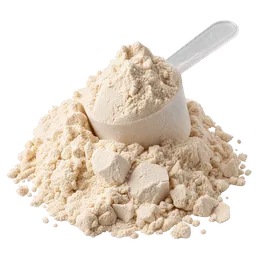
Protein is a nutrient made from amino acids, the small parts your body uses to build and repair tissue. You get it from foods such as dairy, eggs, meat, soy, beans, and grains, while powders offer a convenient concentrated option. 2
Resistance exercise tells muscle to remodel itself, and protein supplies the amino acids for that job. Think of training as issuing a construction permit and dietary protein as delivering the bricks: without enough bricks, the rebuild has less to work with. After exercise, protein intake increases the process that assembles new muscle proteins. 3
Bottom line
Protein supplements make sense if you lift regularly and struggle to get enough protein from meals, especially when convenience keeps you consistent. Expect a modest edge, not a transformation, because training remains the main driver of muscle and strength gains. 1 2 Skip the fat-loss expectations: current evidence does not show a meaningful standalone effect on body fat. 1
Common questions
Does protein powder build muscle?
Does extra protein help you lose body fat?
Is it better to take protein before or after a workout?
Sources
Sources
- 1. A systematic review, meta-analysis and meta-regression of the effect of protein supplementation on resistance training induced gains in muscle mass and strength in healthy adults (2018) ↑
- 2. Protein supplementation augments the adaptive response of skeletal muscle to resistance-type exercise training: a meta-analysis (2012) ↑
- 3. Ingested protein dose response of muscle and albumin protein synthesis after resistance exercise in young men (2009) ↑
Generated August 27, 2026
Related
More evidence for Protein
Ingredient evidence
Ingredient evidence
NewArginine
All scored outcomes
Aug 27, 2026
Ingredient evidence
Ingredient evidence
NewAshwagandha
All scored outcomes
Aug 27, 2026
Ingredient evidence
Ingredient evidence
NewBCAAs (Branched-Chain Amino Acids)
All scored outcomes
Aug 27, 2026
Ingredient evidence
Ingredient evidence
NewBetaine
All scored outcomes
Aug 27, 2026
Ingredient evidence
Ingredient evidence
NewCreatine
All scored outcomes
Aug 27, 2026
Ingredient evidence
Ingredient evidence
NewL-Leucine
All scored outcomes
Aug 27, 2026